

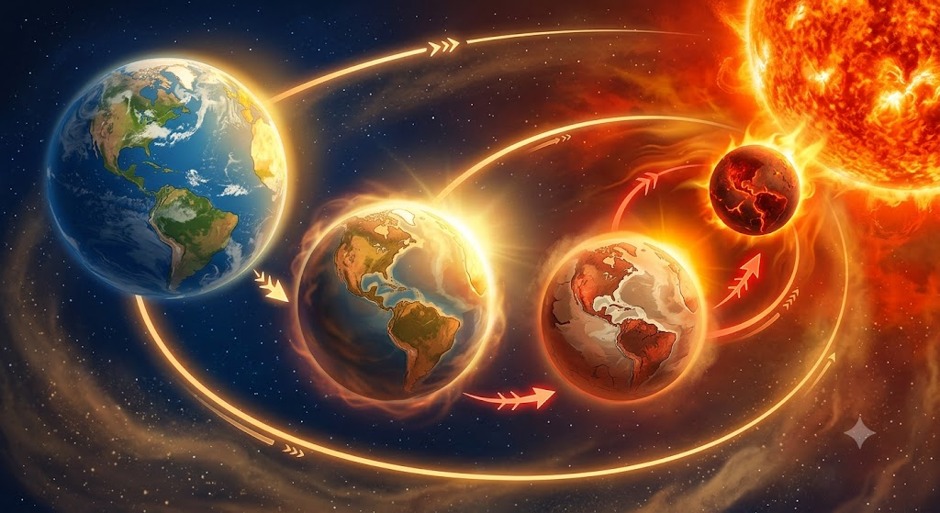
What if Earth drifted a little closer to the Sun each year? Explore rising heat, shifting seasons, and a planet slowly adapting to a new reality.
You wake and stretch, and the first thing you notice is the warmth. It settles across your face before your eyes open, carrying the faint smell of coffee from somewhere down the hall. For a moment, it all feels ordinary, until something holds on just a little too long.
The light through the window feels sharper than it should. The floor beneath your feet warms faster than you remember. Unlike most small morning strangeness, this one does not dissolve; it lingers, pressing itself into the back of the mind. Therefore, a quiet thought begins forming from that small shift: what if Earth had drifted just a little closer to the Sun?
Our Steady Sun
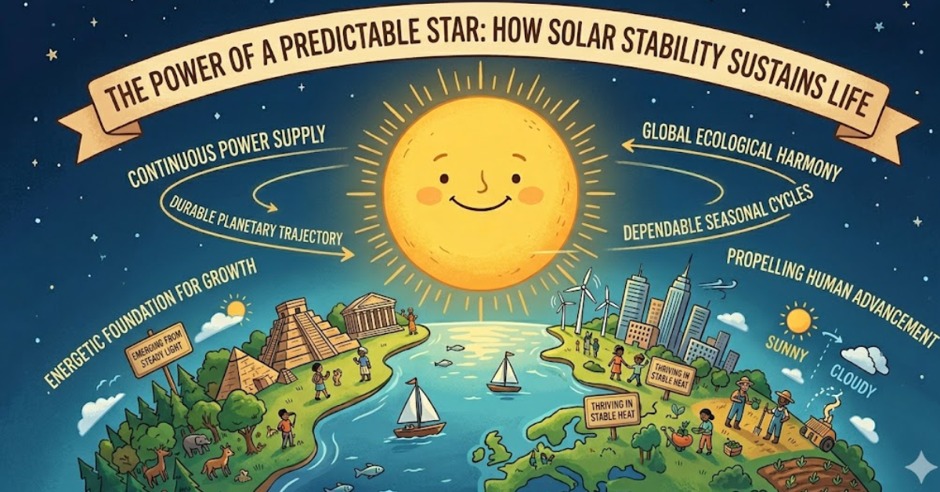
The Sun, under normal circumstances, is predictable rather than dramatic. It converts hydrogen into helium with such reliability that entire civilisations have been built around it. Scientists classify it as a main-sequence star, meaning its energy output stays relatively stable over immense timescales.
That stability is everything. It allows oceans to hold their shape, seasons to turn predictably, and ecosystems to stay balanced across millions of years. We rarely notice any of it, which is precisely why imagining even a slight shift feels so significant. What we never notice is usually what everything else depends on.
The First Whisper of Change
At first, the difference is easy to dismiss. You step outside, and the morning air already carries warmth it should not have. Puddles from overnight rain vanish while the commute is still underway; the pavement sends up its heated smell hours earlier than usual; the day feels like it has skipped a gear.
Your body responds faster than your mind does. Research from the National Institute of Health shows that even moderate heat pushes the circulatory system to work harder, redirecting blood flow toward the skin to release warmth. You feel it as a low-level effort, a heaviness gathering in your muscles while the morning is still settling in, and you find yourself moving more carefully, conserving energy without quite deciding to.
That same pressure reaches beyond the body. The neighbourhood feels quieter than it should; birds call at the wrong hour, some not at all. A shift in the air has rearranged the rhythm they have always followed, and the world around you falls into step with it.
Months Pass
Over the following months, that small adjustment becomes impossible to ignore, and the cost begins to show.
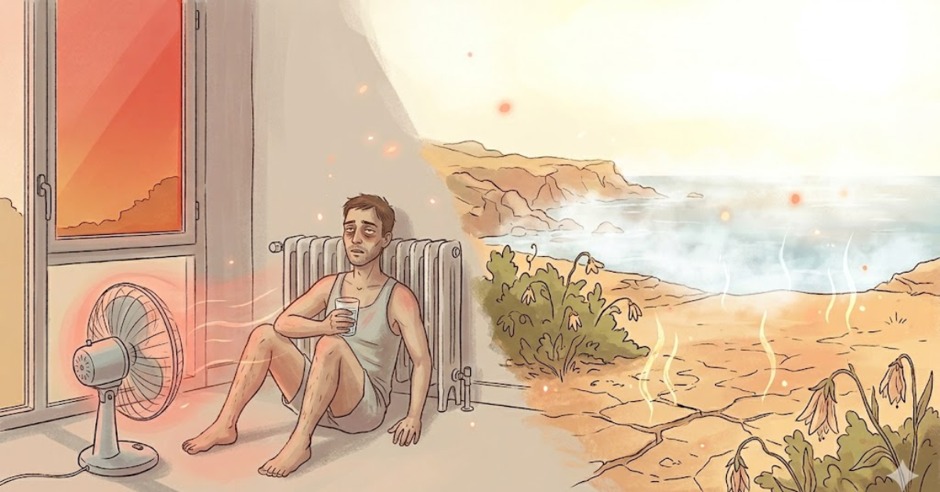
Morning light arrives with greater intensity, and the air outdoors carries a drier edge, somewhere between warmed soil and sunlit stone. Leaves curl earlier in the day to conserve moisture; flowers close their petals by noon; coastlines carry a sharper salt trace as warming oceans release more water into the air above them.
By midmorning, your throat carries a dryness that water does not quite resolve, and your skin stays perpetually warm to the touch, as though the heat has gathered beneath the surface and found no reason to leave. Sleep arrives later and ends earlier; the night is no longer cooling enough to reset the body. Tensions accumulate: the fan that used to be enough, the window now kept shut because the outside air offers no relief, the glass of water reached for in the haze of half-sleep.
The sky itself starts looking different. As the atmosphere absorbs more energy and expands, humidity lingers in unexpected places, and heat haze softens the horizon into a bright, harsher white. The changes no longer feel scattered; they connect into something larger, the pattern of it becoming harder to ignore with each new week.
Year by Year
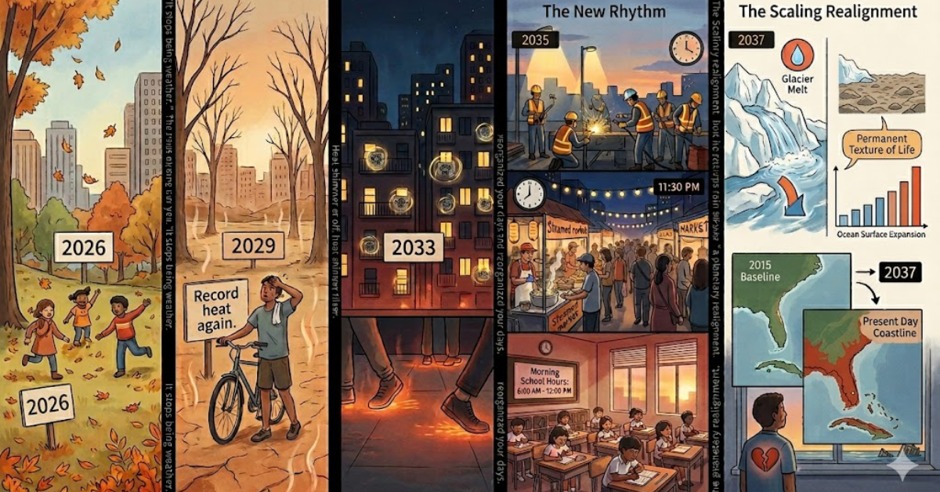
That pattern does not stay confined to a single season. The same warmth returns the year after, and the year after that, until it stops being weather and becomes the permanent texture of daily life, carrying a weight different from the heat itself.
You stop expecting the evenings to cool; you stop expecting sleep to feel like recovery. Cities trap heat long after sunset, the nights heavy and slow, pavement radiating warmth through the soles of your shoes at midnight, the hum of air conditioners the only sound that feels reliable in the dark. Without deciding to, you have reorganised your days around the heat, moving through the cooler hours and waiting out the rest, and soon that same adjustment reaches well past your own routine.
Schools shift their hours toward dawn, ending classes while the afternoon’s worst heat is still gathering elsewhere. Markets grow livelier after sunset, their busiest hours moving deeper into the night. Construction crews gather in the hours leading up to sunrise, beneath portable lights, and parks and public squares sit nearly empty through the middle of the day. Entire cities settle into a new rhythm built around the shrinking windows of relief the planet still offers.
And NASA climate modelling also confirms that even small orbital variations amplify into systemic shifts over time. Glaciers thin; ocean surfaces expand; rainfall patterns fracture; and you feel that fracturing personally, long ahead of any report catching up with it, in the specific way the air smells when a storm gathers and then changes its mind, in the dry scratch at the back of your throat that has become so familiar you have stopped noticing it as unusual. Moreover, the coastlines on old maps no longer match the ones outside the window, and that discrepancy, small as it appears, lodges in the chest in a way that does not quite resolve.
What began as a slightly warm floorboard has scaled into a planetary realignment. And somewhere far beyond this window, on a world where the math worked out differently, it already has.
Distant Mirrors
That thought does not stay abstract for long. The cosmos is already running this exact experiment on planets where the outcome went further than a few warmer afternoons.
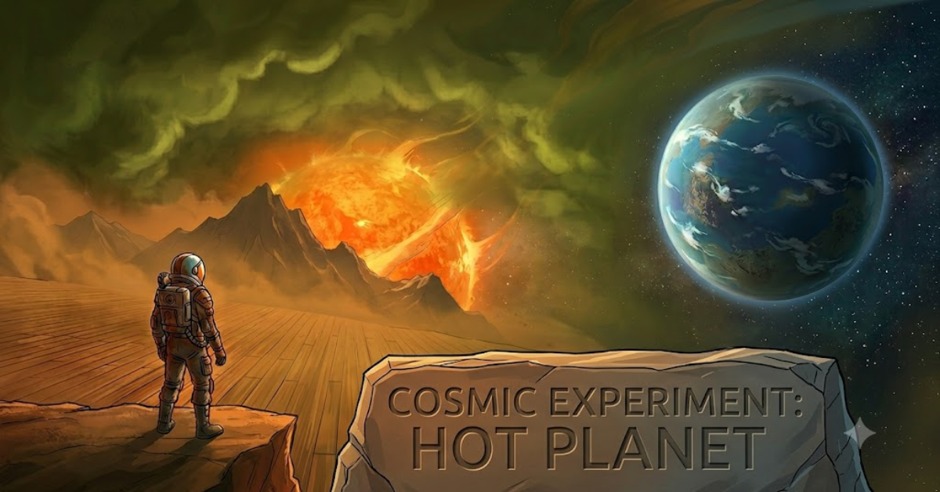
Imagine standing on one of those worlds, orbiting close enough to its star that the air itself would feel thick against your skin and would carry a faint metallic edge with every breath. There, heavier skies and relentless heat would simply be the weather, the only kind anyone would have ever known. Some would sit close enough to their stars that even a small temperature rise would not merely change the forecast; it would trigger runaway greenhouse warming, strip the atmosphere, and boil away whatever water might have existed.
Venus, our closest planetary neighbour, stands as the starkest proof of that outcome, its surface locked at around 465 degrees Celsius beneath a crushing atmosphere that crossed the point of no return long ago. Imagine the floorboard from this morning, except the warmth would never leave, and the room would never cool again.
So, the distance from a star is not just a measurement. It is what shapes a planet’s entire story, determining whether oceans form or evaporate, whether atmospheres hold or scatter, and whether life finds a foothold or never begins at all.
Back to the Window
That thought carries you back home, to where it all began.
Sunlight spreads across the floor near the window, warming the same familiar surface beneath your feet, and the faint smell of coffee reaches you from down the hall, exactly as it did this morning. Nothing has actually moved. Earth remains held in its precise balance of gravity and motion, orbiting at the same distance it always has.
But the light feels different now, not because it has changed, but because you have followed where it could go.
What we call ordinary turns out to be far more precisely arranged than it appears. The stable mornings, the turning seasons, the nights that cool reliably enough to let the body rest: all of it rests on a distance so well measured that even a slow drift would reshape everything connected to it. The warmth on your face right now, the birds outside, the puddles still sitting in the road: none of it is accidental, and none of it is guaranteed to last.
Sources
The following sources were consulted while writing “What If Earth Drifted Closer to the Sun Every Year?”
- Climate change: incoming sunlight
https://www.climate.gov/news-features/understanding-climate/climate-change-incoming-sunlight - How does the sun affect weather and climate?
https://maweb.org/how-does-the-sun-affect-weather-and-climate/ - Humidity turns urban heat into an all-night threat
https://salatainstitute.harvard.edu/humidity-turns-urban-heat-into-an-all-night-threat/ - Impacts of 1.5ºC global warming on natural and human systems
https://www.ipcc.ch/report/sr15/chapter-3-impacts-of-1-5oc-global-warming-on-natural-and-human-systems/ - Nuclear fusion in the sun: how the ultimate sun power source enables lifelong energy generation
https://www.sciencetimes.com/articles/60792/20251114/nuclear-fusion-sun-how-ultimate-sun-power-source-enables-lifelong-energy-generation.htm - The images in this blog are created with the support of an AI tool and reviewed by the author.



Comments