
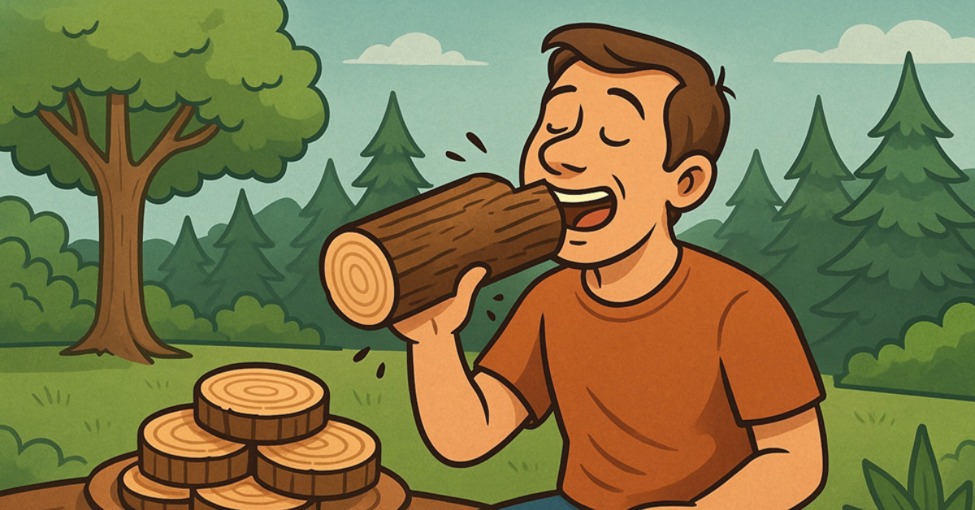
What if human beings could eat wood? Furniture turns into food, forests become meals, and hunger fades, but nutrition, biology, and survival take a strange turn.
You are sitting at your table, absently running your fingers along its edge while waiting for food to arrive. The surface feels smooth, solid, and familiar, something you have never questioned before.
Then a strange thought slips in and refuses to leave: what if this were food?
You glance at the chair, the door frame, and the wooden shelf by the window. The idea spreads faster than it should. What if hunger worked differently, and the world around you quietly became part of what you consume every day? Once the thought settles in, it becomes difficult to look at anything wooden the same way again.
The First Bite
You hesitate for a moment before finally bringing a small splinter to your mouth, more curious than confident.
The first thing you notice is how stubbornly wood resists. Unlike ordinary food, which yields to the teeth, wood demands a brutal, repetitive effort. Your jaw works far longer than expected, grinding dry, jagged fibres that scrape against your tongue. The taste is a revelation of the “un-edible”: a dusty, earthy bitterness somewhere between old bark and parched soil.
Moreover, swallowing offers no relief. A dense, cold heaviness settles into your stomach almost immediately, as if your body recognises it has just inherited a burden it was not designed to carry. Eating stops feeling like a pleasure and becomes a chore your body must solve.
Why the Body Struggles
That heaviness is the weight of cellulose, the complex carbohydrate that gives trees their rigid strength.
Human biology lacks the key to unlock this energy. Animals that survive on wood, like termites, rely on a hidden partnership with microorganisms and bacteria in their gut to ferment and break down those fibres. If humans somehow developed this ability, our lives would slow down because digestion would become a full-time job.
Energy would arrive in slow, agonising drips rather than quick bursts. Even after eating enough to feel physically stretched and full, a phantom hunger would remain, a sign that your body is working overtime for very little reward.
Food Everywhere
As you step outside, your map of the world shifts.
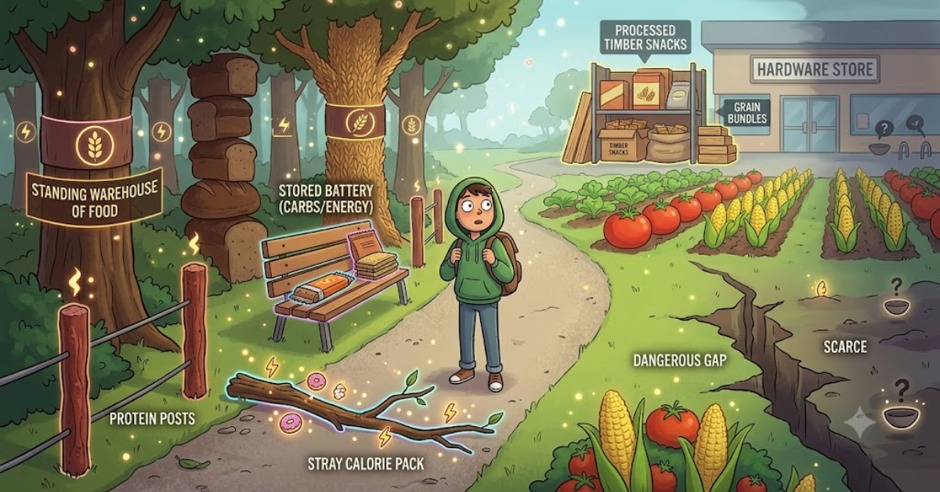
A fallen branch near the sidewalk is no longer debris; it is a stray calorie. The wooden bench in the park feels less like furniture and more like a stored battery. Fence posts, tree bark, and timber stacks outside a hardware store all move into a new category in your mind.
Agriculture would no longer be confined to the flat, tilled earth of a farm. Forests, once viewed as places of beauty or shade, would suddenly be seen as vast, standing warehouses of food. But as the availability of calories grows, a more dangerous gap begins to appear.
The Nutritional Gaps
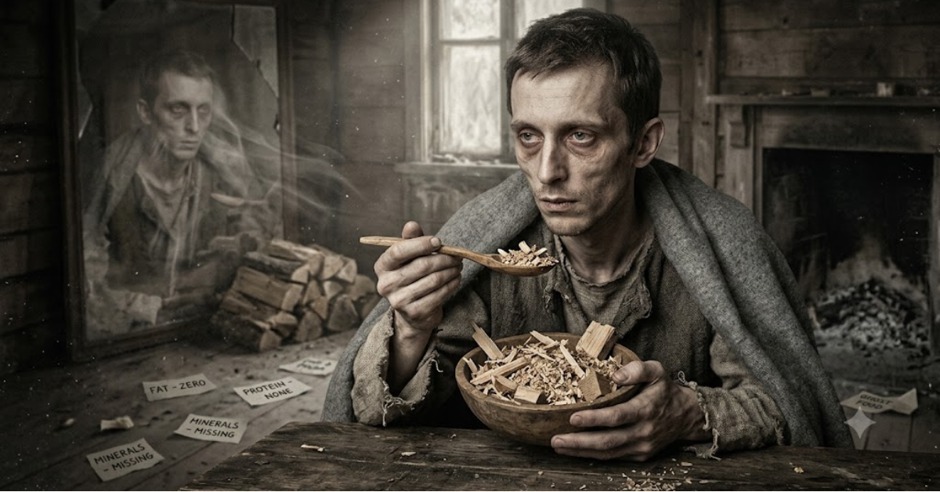
Wood might provide raw energy, but it is a “ghost food.” It contains almost no usable fat, very little protein, and none of the vital minerals needed to maintain human muscle or immune function.
At first, the effects are quiet. A slight lag in your step, a fog in your thinking that does not match how “full” you feel. Over time, the paradox becomes impossible to ignore: your stomach is heavy with fibre, yet your cells are starving for nutrients that the wood cannot provide. Meals stop being about nourishment and start becoming about the endless, hollow maintenance of a body that is slowly running out of parts.
A Shifting World
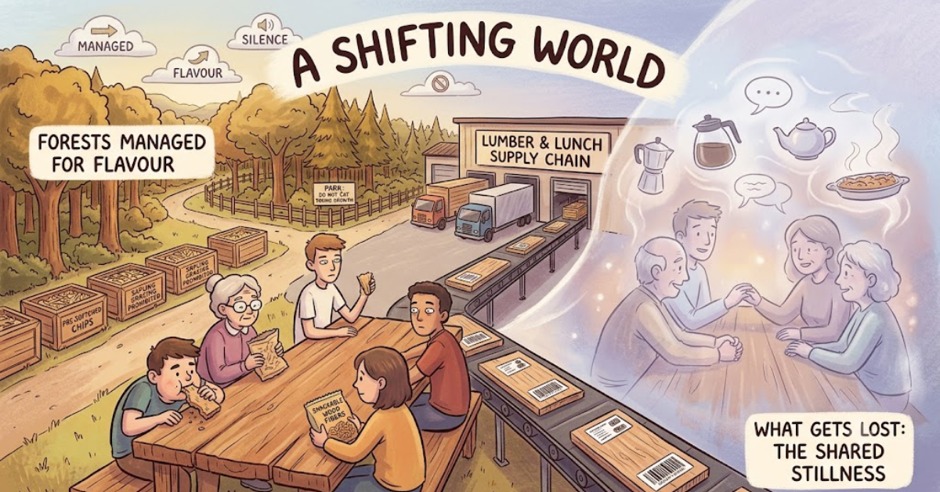
As the diet changes, the forest is no longer protected for its silence; it is managed for its flavour.
Timber is no longer just for shelter. Different species would carry different values. We might see stores selling processed, pre-softened wood fibres beside ordinary snacks. Parks would be fenced off specifically to prevent people from grazing on young saplings, and the lumberyard would effectively transform from a construction site into the back end of a grocery supply chain.
What Gets Lost
However, food has never been just about survival; it is about the pause.
Meals create the structure of our day. They organize our routines and give our conversations a place to happen. Sitting around a table is often less about hunger and more about the shared stillness. Without the need to “prepare” a meal, if you can simply gnaw on the corner of the table while you speak, the ritual of gathering begins to fade.
The table remains solid and familiar beneath your hand, but it loses its spirit. It stops being a place of connection and becomes just another piece of the pantry.
The Thought That Stays
You run your fingers along the table one more time. It feels exactly the same as it always did.
Nothing about the wood has changed physically, yet you can no longer see it as an object. The boundary between what is “edible” and what is “environment” was never fixed; it was only a reflection of what your body was capable of doing.
The table stays where it is. But as you walk away, you realize you are not just looking at furniture anymore. You are looking at a world that is suddenly, terrifyingly, delicious.
Sources
The following sources were consulted while writing “What if Human Beings Could Eat Wood?”
- Are you eating wood? The real story behind cellulose in food
https://www.doolly.com/blog/are-you-eating-wood-the-real-story-behind-cellulose-in-food - Chewing wood could give your brain an unexpected boost
https://www.sciencealert.com/chewing-wood-could-give-your-brain-an-unexpected-boost - How does nutrition affect oral health?
https://utni.org/whats-fresh/nutrition-and-oral-health - Human gut microbiota in health and disease: Unveiling the relationship
https://pmc.ncbi.nlm.nih.gov/articles/PMC9549250/ - Main nutritional deficiencies
https://pmc.ncbi.nlm.nih.gov/articles/PMC9710417/ - The images in this blog are created with the support of an AI tool and reviewed by the author.




Comments