

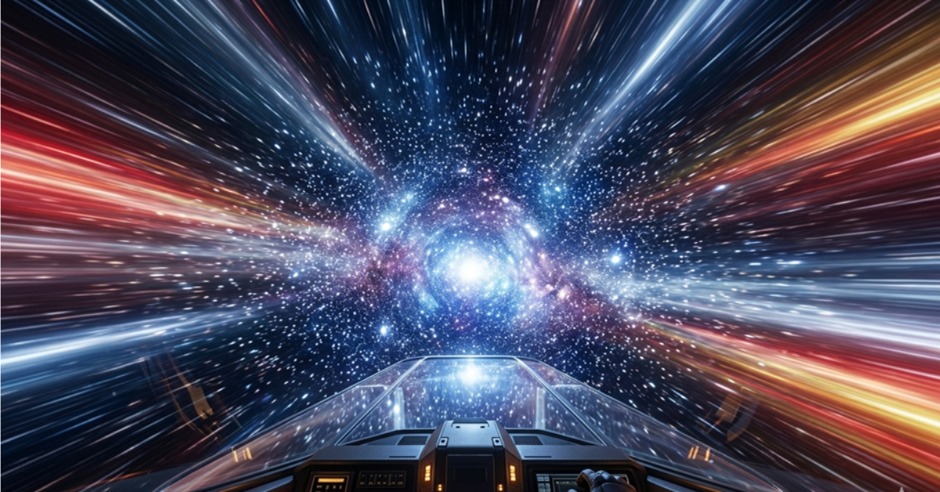
What happens if you move as fast as light? Streets blur, stars bend, and time slips as physics quietly rewrites reality.
You are standing in the kitchen early in the morning, watching sunlight slide slowly across the countertop while steam curls upward from a fresh cup of coffee. Outside, a delivery truck moves down the quiet street, its low engine hum fading between houses.
Everything around you follows a pace your body understands: footsteps on tile, a kettle clicking off, the soft blink of a microwave clock.
Then your eyes settle on the bright patch of sunlight on the counter. That light left the Sun eight minutes ago, racing across the vast emptiness of space to touch your counter.
The thought lingers for a moment, quiet but unsettling: what happens if you travel at the speed of light?
The Speed You Know
Most motion in your life happens at gentle speeds. When a car drives past your house, it feels fast; when an aeroplane crosses the sky, it feels astonishing, yet both move painfully slowly compared with light itself. Light races through space at nearly 300,000 kilometres every second: enough to circle the Earth more than seven times before you even think to blink again.
Your body senses motion at a gentler pace, catching rhythms it can follow almost without thinking. On a train, the scenery drifts past the window, your drink rocking gently in its cup, teasing the strange possibility of what happens if everything around you suddenly blurs into streaks of colour and sound.
Sprint across a busy street before the signal changes, and air presses against your face while your heartbeat climbs slightly. Motion always leaves small signals in the body: muscles tighten, breath shifts, and balance adjusts.
Even when you stand still, light rushes everywhere around you. Sunlight warms your arms; reflections bounce off glass buildings; and distant starlight travels unimaginable distances before reaching your eyes.
Realizing that can leave you with a strange sensation: the universe has been racing quietly around you the entire time. A quiet thought stirs: what happens if you leave the familiar pace of everyday life behind and begin travelling at the speed of light?
The First Rush
Now imagine stepping outside and pressing a button that launches you forward.
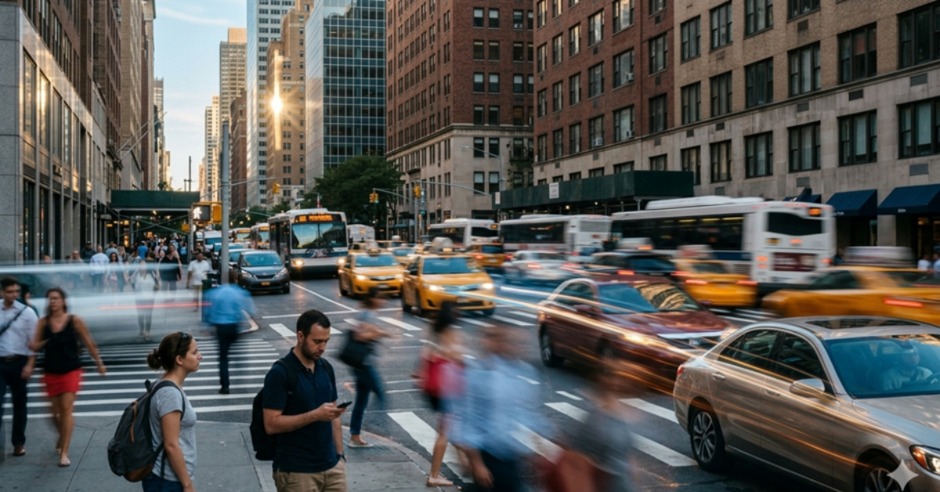
At first, the movement feels like riding a fast motorcycle. Pavement slides quickly beneath your feet; wind pushes against your jacket, cool and loud. Trees along the road smear into streaks of green while road signs flash by before your brain has time to read them.
Within seconds, your senses struggle to keep up.
A dog barking somewhere behind you stretches into a warped echo. Your eyes water from the rushing air; your stomach tightens slightly, the same nervous excitement that comes with the first drop of a roller coaster.
Meanwhile, physics begins to change in various ways.
Experiments with fast-moving particles show that time itself shifts as speed increases. Clocks travelling extremely fast tick slightly slower, a phenomenon called time dilation that physicists have repeatedly measured and explained in accessible detail by Encyclopedia Britannica.
You glance at your watch out of habit, noticing its steady rhythm drifting away from the world behind you.
When the World Blurs
Acceleration continues; the street beneath you becomes a flowing ribbon.
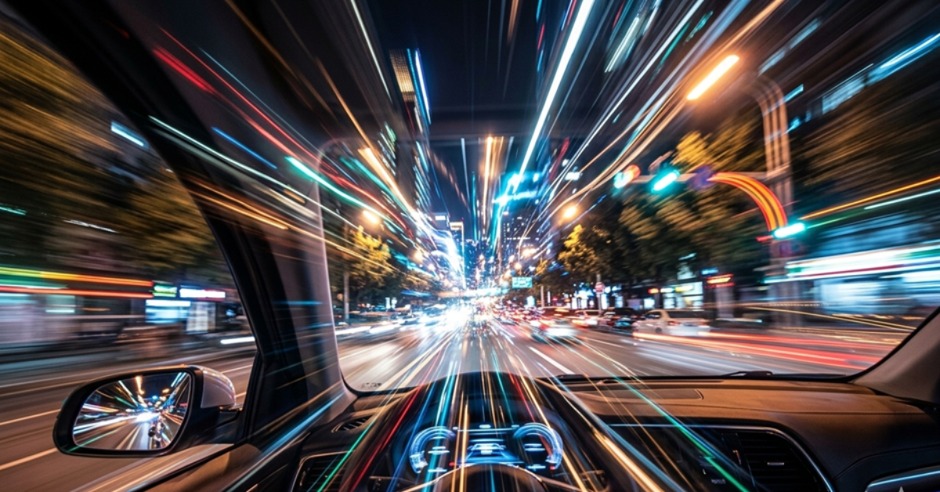
Streetlights stretch into glowing lines. Passing cars flatten into flashes of colour. You pass a playground where children are laughing only moments ago, yet the sound fades instantly as your motion carries you far beyond it.
For a moment, the entire scene seems to pause, almost frozen. Then something stranger begins happening, at a scale you cannot see. Scientists studying particle collisions in the Large Hadron Collider (LHC) at CERN have observed that matter moving close to the speed of light behaves differently. As particles gain enormous energy during acceleration, their behaviour begins to resemble waves more than solid objects.
You cannot feel those microscopic changes, yet imagining them sends a small chill across your arms.
The faster you move, the more the universe itself begins to respond.
When the Sky Bends
Soon, the landscape beneath you dissolves completely. Cities, forests, and oceans blend into streaks of colour rushing past your vision. You glance upward; the sky no longer looks familiar.
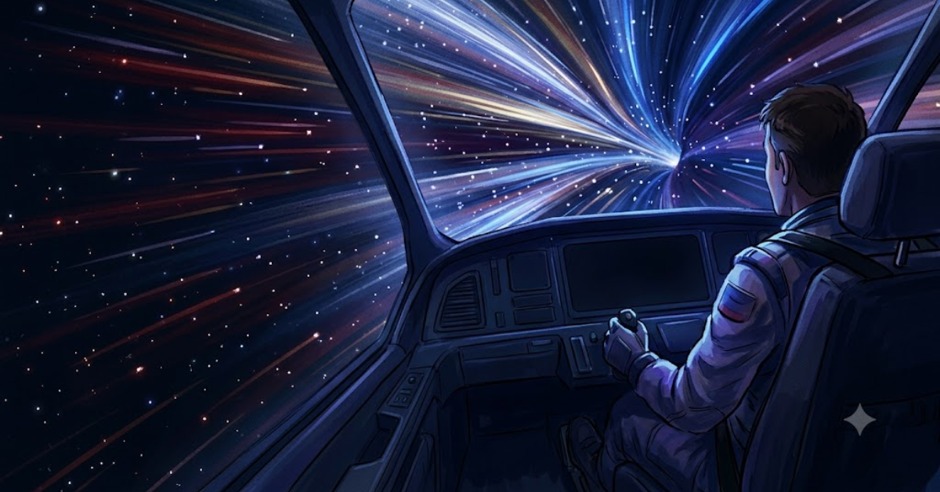
Stars ahead of you begin gathering toward the centre of your view while those behind stretch outward, their colours shifting almost imperceptibly as light compresses, warmer tones tightening toward pale white while cooler hues sharpen faintly at the edges. Astronomers call this relativistic aberration, an effect predicted by Einstein and discussed in educational material from NASA.
It feels as if the night sky is collapsing into a glowing tunnel in front of you.
The sight steals your breath for a moment: the same quiet awe people feel when they stand at the edge of a canyon or watch a total solar eclipse.
Back on Earth, ordinary life continues. Someone pours cereal into a bowl. A bus stops at a red light. A classroom clock ticks forward another second.
Yet your own clock drifts slowly out of sync with theirs; hours might pass for others while only minutes pass for you.
The Universe’s Limit
Eventually, a quiet realization returns.
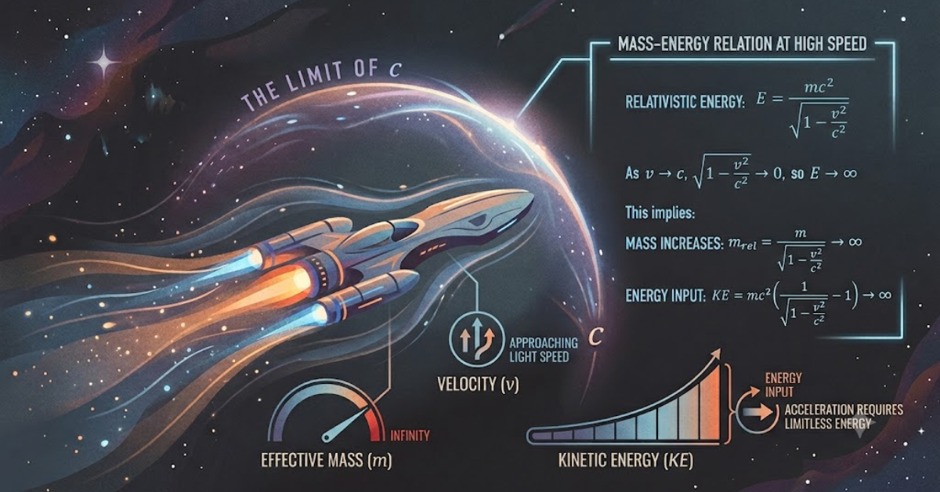
Reaching the speed of light is not something ordinary matter can do. As an object speeds up, it needs more and more energy to keep accelerating. At the same time, its effective mass increases with speed, a relationship explained by Albert Einstein through mass–energy equivalence, often written as E = mc².
This creates a natural resistance to further acceleration. Each push adds less of an increase in speed, while the energy required grows dramatically. By the time an object approaches the speed of light, the required energy becomes effectively infinite, making it physically impossible to reach that speed.
Even at these extremes, the environment turns hostile in ways that feel almost unreal. Even tiny dust particles become dangerous. At extreme velocities, a grain no larger than sand hits with explosive force, carrying enough energy to behave like a microscopic bomb. It is one of the hazards engineers studying future high-speed spacecraft account for when designing future missions.
Yet even after that realization settles in, another thought follows naturally. The universe allows you to come astonishingly close to that speed; every burst of acceleration pushes you nearer to the limit. Still, the final step always remains out of reach, held back by the quiet rules woven into the fabric of physics.
Seeing Light Differently
You find yourself back in the kitchen again.
Your coffee has cooled slightly; the street outside looks the same. A neighbour walks a dog across the sidewalk, while sunlight slowly moves across the floor.
Nothing about the room has changed.
Yet the beam of light touching the countertop suddenly feels different. It is not just brightness warming the kitchen; it is the fastest traveller in existence, racing across the cosmos before quietly arriving beside your cup.
And while the world around you continues at its familiar pace, your imagination has already taken a journey that moves far faster than anything ever built.
Sources
The following sources were consulted while writing “What Happens If You Travel at the Speed of Light?“
- What would happen if you moved at the speed of light?
https://www.space.com/what-would-happen-if-you-moved-at-speed-of-light? - Special relativity explained: Einstein’s mind-bending theory of space, time and light
https://www.space.com/36273-theory-special-relativity.html? - Three Ways to Travel at (Nearly) the Speed of Light
https://www.nasa.gov/solar-system/three-ways-to-travel-at-nearly-the-speed-of-light/? - How far is a light-year? Plus, distances in space
https://earthsky.org/astronomy-essentials/how-far-is-a-light-year/ - Would Headlights Work at Light Speed?
https://www.youtube.com/watch?v=ACUuFg9Y9dY - The images in this blog are created with the support of an AI tool and reviewed by the author.




Comments