


What if you could see chemical bonds? Discover the hidden architecture of chemical bonds and how seeing the invisible could revolutionize the future.
You’re scrolling through this blog on your phone, barely thinking about it, when something feels off. The screen isn’t glowing with notifications anymore. Instead, thin, shimmering threads begin spreading across its surface. Then the air lights up too. Lines stretch from your phone to your hands, from your hands to your body.
You’re not imagining it.
You’re seeing chemical bonds.
Now imagine you could always see them, not through microscopes or gadgets, but with your own eyes. Threads connecting atoms would glow everywhere, weaving luminous patterns through the world around you. If that hidden architecture suddenly became visible, how would it change the way you see reality?
At first, it sounds like a science-fiction superpower. In reality, it would reveal a hidden world that shapes everything around you, much like the invisible force of gravity quietly shapes the universe every second.
To understand what you would actually see, you first need to understand chemical bonds.
The Hidden World of Chemical Bonds
As the glowing threads spread around you, one question becomes impossible to ignore:
What exactly are you looking at?
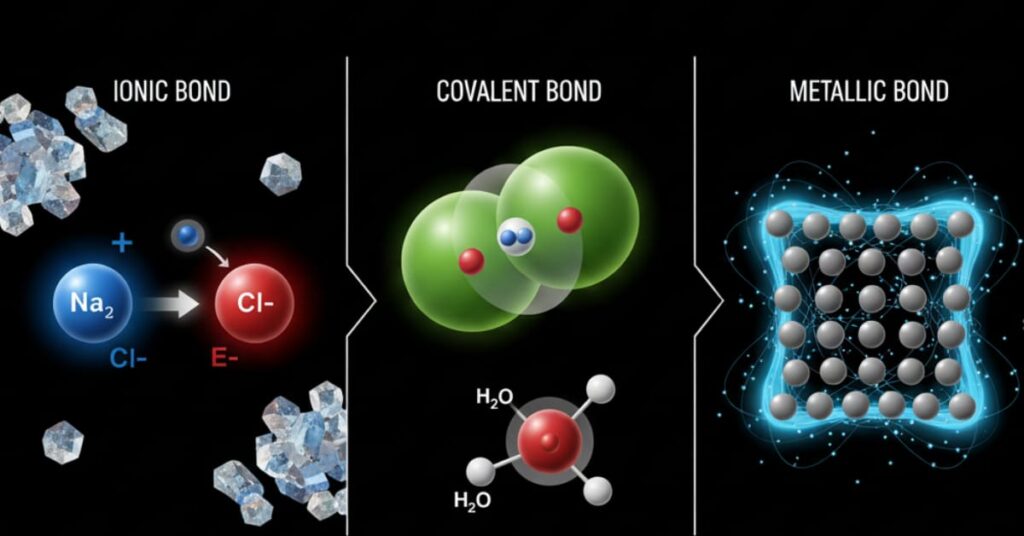
A chemical bond is the force that holds atoms together to form molecules. Without it, atoms would drift apart, and the water you drink, the air you breathe, and even your own body could not exist.
Think of chemical bonds as the invisible glue that holds the universe together. Like the countless bacteria quietly supporting life around and inside you, they shape your world despite remaining completely unseen.
Now that you know what those glowing threads are, you begin noticing something even stranger.
Not every bond looks the same.
The 3 Types of Chemical Bonds You Should Know
Still staring at the glowing threads, you glance at your phone and realize something surprising.
Metallic Bonds

Beneath your phone’s metal frame and through its tiny circuits, the glow flows like a shimmering current instead of fixed threads. Electrons move freely through the structure, giving metals their strength and ability to conduct electricity. This is a metallic bond.
Covalent Bonds

Curious, you walk into the kitchen and reach for a glass of water. Inside, the glow changes completely. Instead of flowing currents, the atoms are connected by steady bridges of light where electrons are shared. The same bonds build carbon dioxide, sugars, proteins, and countless molecules inside your own body. These are covalent bonds.
Ionic Bonds

You set the glass down and notice a grain of salt on the counter. Here, the glow crackles like frozen lightning. One atom has given up an electron, another has accepted it, and their opposite charges lock them together. The same powerful attraction holds together baking soda, many minerals, and even compounds inside the toothpaste by your bathroom sink. This is an ionic bond.
What Happens If You Could See These Bonds?
You put your phone down and look around the room. Suddenly, nothing looks ordinary anymore. Your coffee cup, the air you breathe, and even your own hands glow with countless shimmering threads connecting every atom.
At first, it feels beautiful.
But as minutes pass, the endless web never disappears. Gradually, the constant glow overwhelms your senses. Faces, walls, furniture, and even your own body dissolve into shifting networks of forming and breaking bonds. Nothing seems truly solid anymore. Time itself begins to feel strangely distorted, much like when your brain loses its sense of time, as your mind struggles to process a world that never stops changing.
For the first time, reality doesn’t feel stable. It feels alive.
How Seeing Bonds Could Revolutionize Science
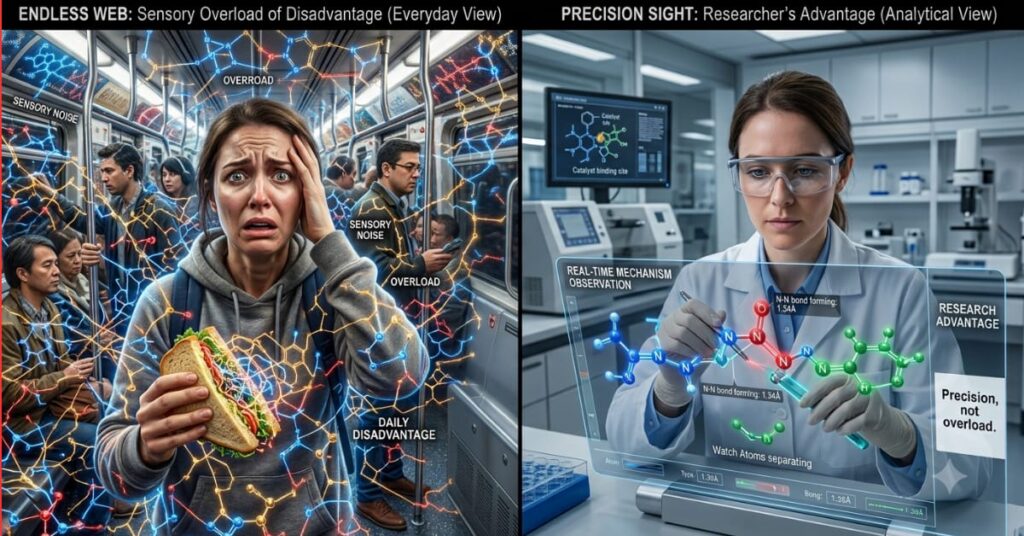
Months pass. While scientists marvel at your extraordinary ability, you can never escape it. Day and night, the endless web of glowing bonds surrounds you, turning even ordinary moments into sensory overload.
For researchers, however, this changes everything. Instead of relying only on models and equations, they could watch atoms connect and separate in real time. Advances in atomic force microscopy have already allowed scientists to image chemical bonds at the atomic scale, bringing that possibility closer than ever.
With every bond visible, scientists could design medicines, stronger materials, and cleaner energy systems atom by atom instead of through years of trial and error. The same ability that overwhelms you could become one of humanity’s greatest scientific breakthroughs.
Why Are Chemical Bonds Invisible to Us?
You blink… and you’re back in your living room, reading this blog. Your phone looks ordinary again. The glowing threads have vanished, and the world feels solid once more.
That’s because chemical bonds are far too small for human eyes to see. Even with powerful instruments, scientists rely on techniques such as X-ray crystallography and atomic force microscopy to reveal their hidden structure.
And perhaps that’s a good thing. If every bond were visible all the time, the endless web of glowing connections would overwhelm your senses, making the world almost impossible to navigate.
The invisible forces holding every atom together never disappeared. They were quietly shaping your world all along, keeping reality stable, organized, and wonderfully ordinary. You just couldn’t see them.
What If We Could Manipulate Bonds Directly?
Now imagine the glowing threads return, but this time you can control them.
With a single thought, you repair a cracked wall, recycle plastic into something new, or build entirely new materials atom by atom. Medicine, energy, and manufacturing could be transformed almost overnight.
But the same power could also become a weapon. The ability to rebuild matter could just as easily destroy it, widening inequality and creating risks we have never faced before.
For now, it remains science fiction. But if humanity ever learns to control chemical bonds directly, it may become one of the greatest and most dangerous breakthroughs in history.
The Takeaway: Invisible Connections Matter
You set your phone down. The glowing threads are gone, but the world hasn’t changed.
Chemical bonds were holding everything together long before you imagined seeing them.
The strongest forces in the universe are often the ones we never notice.
What invisible forces are shaping your world right now, even though you’ll never see them?
Sources
The following sources were consulted while writing “What If You Could See Chemical Bonds?”
- Noncontact atomic force microscopy: Bond imaging and beyond
https://www.sciencedirect.com/science/article/abs/pii/S0167572920300303#:~:text=rights%20and%20content-,Abstract,as%20determining%20molecular%20electronic%20characteristics - Chemical Bonding: The Journey from Miniature Hooks to Density Functional Theory
https://pmc.ncbi.nlm.nih.gov/articles/PMC7321411/ - Chemical Bonds
https://courses.lumenlearning.com/suny-ap1/chapter/chemical-bonds/ - The images in this blog are created with the support of an AI tool and reviewed by the author.





Comments