

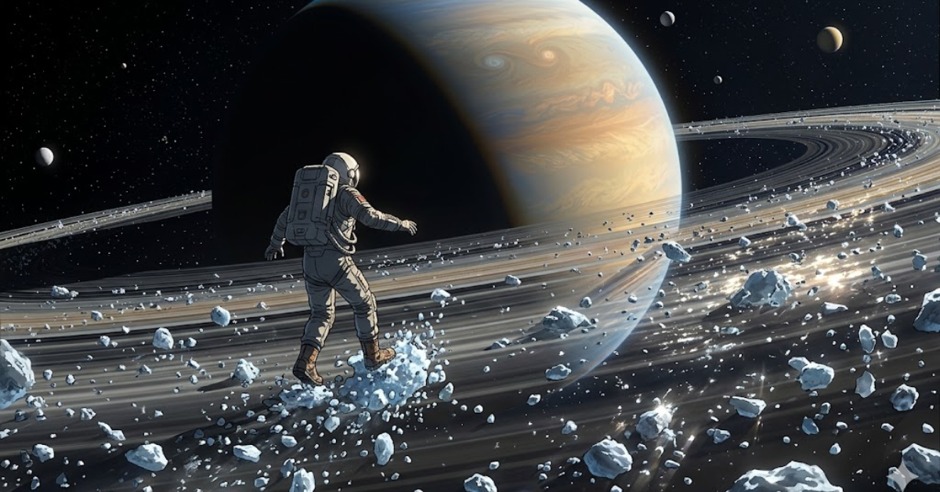
What If You Walk on Saturn’s Rings? Explore shifting ice, low gravity, extreme cold, and dazzling light with every step.
You step into your apartment, holding a cup of coffee, while the night sky stretches above in a way that usually feels familiar and routine. Saturn appears as a distant point, something you might notice briefly before moving on. Yet, tonight, your attention stays on it a little longer, especially on its rings forming a thin band around the planet.
A question begins to form in a straightforward way: what if you actually walk across those rings?
The quiet hum of appliances and distant street noise continues behind you, but your focus shifts outward. You imagine standing inside an airlock orbiting Saturn, with the planet filling the window at a scale that is difficult to fully process. The floor beneath your boots feels steady, yet your awareness sharpens as if preparing for an unfamiliar environment, and that sense of readiness leads your attention toward what lies beyond the glass.
A Fragile Path
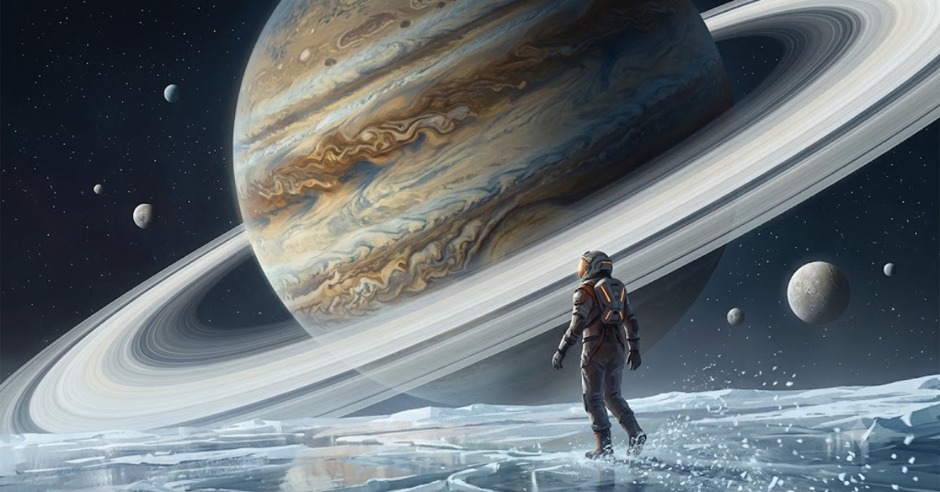
From a distance, Saturn’s rings appear smooth and continuous, almost like a solid surface, but as you move closer, that appearance changes. What once looked uniform now separates into countless pieces of ice and rock, ranging from tiny particles to fragments as large as buildings, each following its own orbit.
You lower your foot carefully. It meets some resistance, but not a firm surface; pieces shift slightly under your weight while others move past at a steady pace.
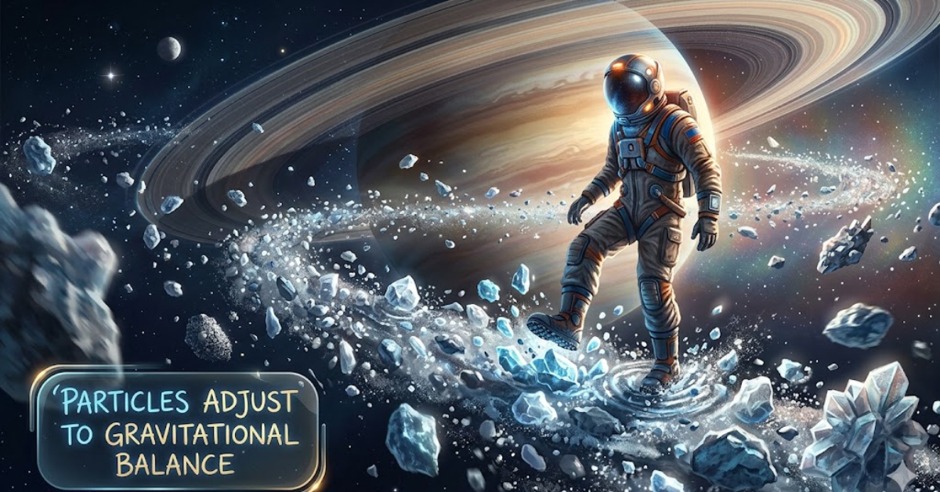
Scientific observations show that the particles in Saturn’s rings stay stable due to a balance of gravitational forces, with each fragment influenced by Saturn and nearby particles at the same time.
As you shift your weight, the material beneath your foot adjusts, instead of collapsing, redistributing itself in response, which naturally leads you to test the surface further with another step.
Sliding Between Particles
That next step changes the experience immediately. Smaller particles move aside, brushing lightly against your boots, while larger pieces pass nearby without fully blocking your movement.
You extend your hand and make light contact with a stream of particles that feel uneven rather than solid, prompting you to move more carefully.
Your body begins adjusting automatically; research on balance shows that stability relies on constant small corrections, especially on uneven surfaces. You notice this happening as your muscles respond in quick, controlled movements, and as your footing becomes more stable, your attention begins to shift toward how light behaves across the surface.

Light That Moves
Sunlight spreads across the rings and reflects off many surfaces at once. Instead of a single steady glow, the light appears scattered, changing as the particles continue moving.
Shadows form between larger fragments and disappear quickly as positions shift.
Observations show that the rings of Saturn reflect a large amount of sunlight, which explains their brightness when seen from far away. Here, that reflection changes continuously, and as you follow these changes, your focus gradually returns to how your own movement fits into this environment.
Gravity’s Gentle Hand
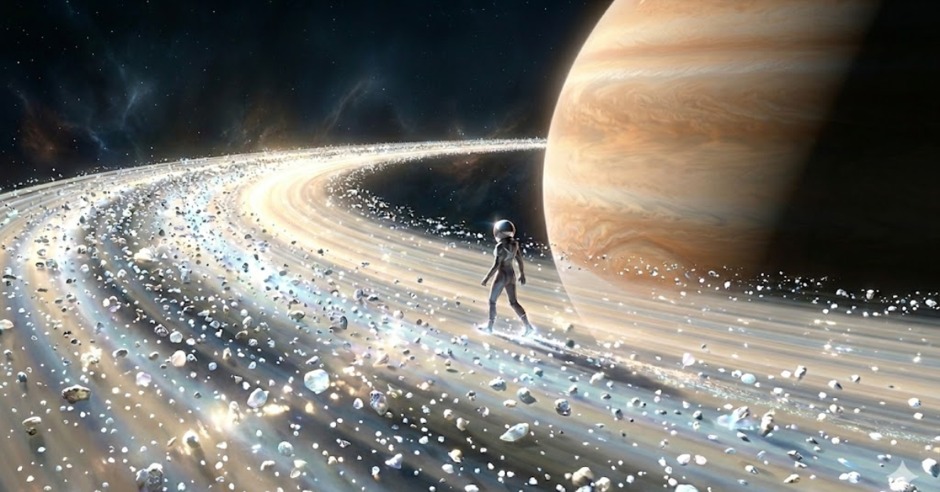
Walking here feels different in a way that takes a moment to register. Your steps hold you in place, yet there is a slight delay, a softness in how your body settles after each movement.
When you push upward, even slightly, your body lifts more than expected before returning, the motion controlled but extended just enough to notice.
Saturn’s gravity, combined with orbital motion, creates a weaker pull than Earth’s, yet it is still enough to keep you connected to the surface. Each step becomes a balance between upward motion and downward force, and as you begin to adjust to that pattern, your attention shifts toward the surrounding conditions.
Cold That Builds Gradually
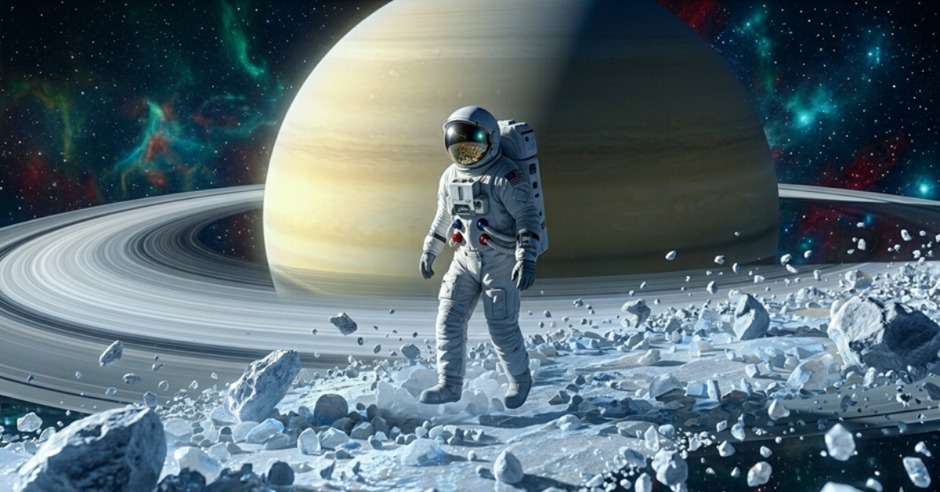
The cold does not feel sudden; instead, it develops through contact with the surface. Temperature transfers slowly from the ice beneath your boots, creating a steady cooling effect.
Your gloves begin to register the same change as heat moves away from your body into the surrounding environment.
Without an atmosphere, heat does not remain in place, and temperatures near Saturn’s rings can reach around minus 140 degrees Celsius. Though this does not stop your movement, it influences it, leading you to move more efficiently, and as you adjust, your focus begins to expand beyond the immediate surface.
A Larger System
You look up, and the scale becomes clear again. The rings extend far beyond your line of sight, forming a thin structure across space, while Saturn fills the sky with visible cloud layers.
Moons move slowly in the distance, adding depth to the environment without drawing immediate attention.
Each step you take remains small compared to this system, yet it connects you to it. The motion beneath your feet, the changing light, and the gravitational pull all belong to the same structure, and as you recognise that connection, your pace naturally slows.
Reflections That Remain
You pause as the environment around you continues to change. Particles keep moving, light continues shifting, and nothing remains completely still.
Your breathing becomes steady, matching observation rather than movement.
Although walking on Saturn’s rings may not be possible in reality, thinking about it reveals something important: what appears solid from a distance often depends on motion, balance, and interaction at smaller scales.
As you return toward the airlock, you take one more look at the shifting surface, recognising that even stable-looking systems rely on continuous movement to exist.
Sources
The following sources were consulted while writing “What If You Walk on Saturn’s Rings?”
- Saturn’s Rings: Composition, Characteristics & Creation
https://www.space.com/23235-rings-of-saturn.html - How cold is space? Physics behind the temperature of the universe
https://www.space.com/how-cold-is-space - What If You Fell Into Saturn?
https://www.youtube.com/watch?v=seopOXWUW3Q - Solar System Temperatures
https://science.nasa.gov/resource/solar-system-temperatures/ - The images in this blog are created with the support of an AI tool and reviewed by the author.



Comments