

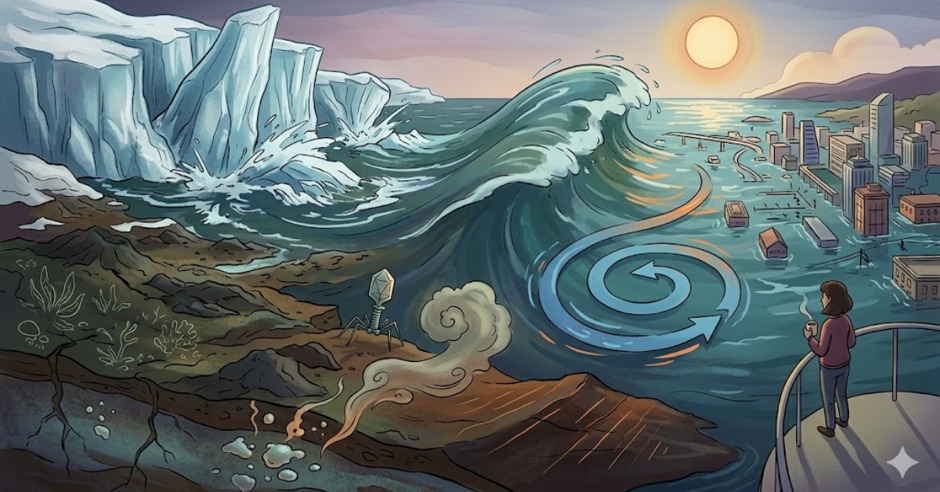
What if all the ice on Earth melted in just seven days? Discover how rising seas, broken systems, and a changing sky would reshape everything you depend on every day.
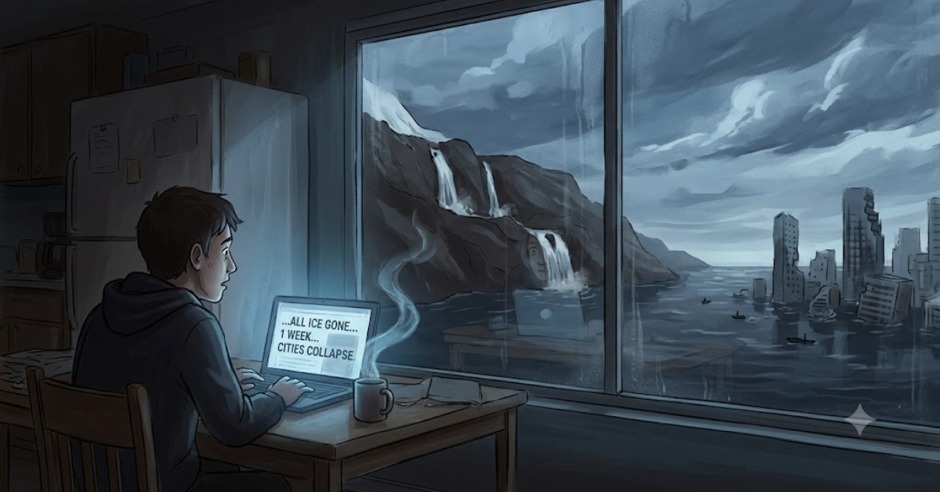
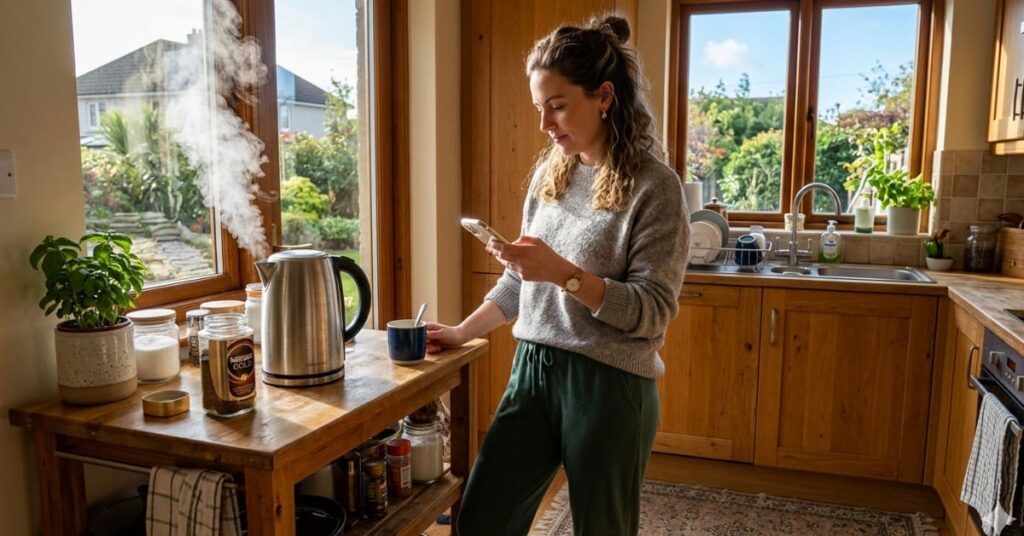
The steam rising from your coffee mug is the only vapour in your life that feels under your control. You blink at the screen, hoping the blue light is just playing tricks on your tired eyes, but the headlines about the polar ice caps disappearing stay fixed in place. This is not a prediction for some distant future; it arrives in your morning like unexpected news.
You look toward the window, half expecting the world outside to appear normal, yet a quiet thought lingers in your mind: if something this massive can unravel this fast, how long before the changes reach your own street?
If all the ice on Earth melted within a single week, the change would not stay in the background for long. Icebergs the size of cities would collapse into open water, and mountain snowcaps would drain like reservoirs left open overnight. Somewhere between checking your phone and finishing your coffee, you start wondering how quickly a familiar place can stop feeling familiar.
You step outside with that thought still following you, as if it has moved into the open air beside you.
Day One: Water Begins to Rise
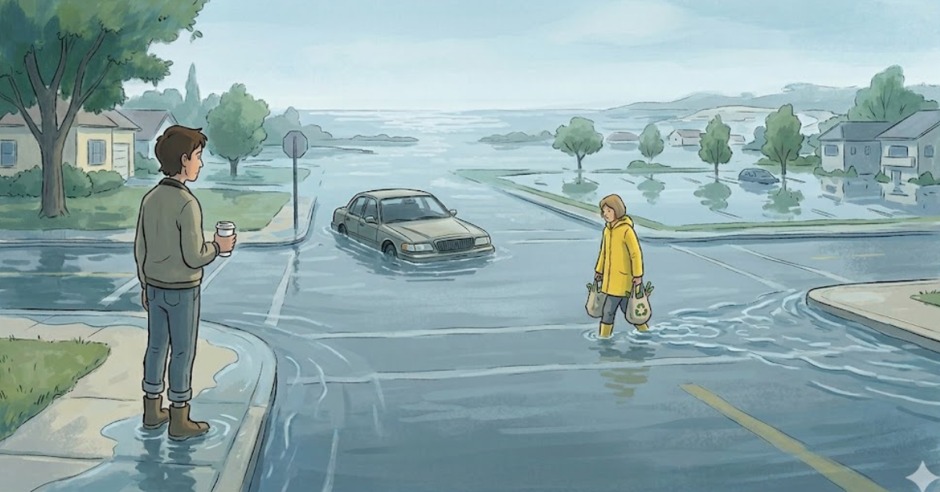
At first, the change feels strangely manageable. Stepping out with your cup still in hand, you notice water spreading along the curb, reflecting the pale morning sky with an unsettling stillness.
A car stands motionless at the intersection with water rising halfway up its doors, while someone nearby carries grocery bags through the flooded street, slowing down each time the current pushes against their legs. For a moment, the scene feels more confusing than frightening, as though your mind has not fully accepted what it is seeing.
By afternoon, the water keeps rising, little by little, covering the edges and landmarks you normally use to understand the space around you. According to sea-level studies, water from melting ice could raise ocean levels by around 66 to 70 meters. As that number becomes visible, coastlines begin disappearing beneath the surface.
Roads that once carried traffic now end underwater. Parking lots become shallow lakes. Entire neighbourhoods lose their shape as the line between land and ocean starts moving inward with passing hours. You step back as water reaches your shoes, and the realization settles in: if the ground itself no longer feels reliable, where do you go next?
Day Two: Movement Becomes Unstable
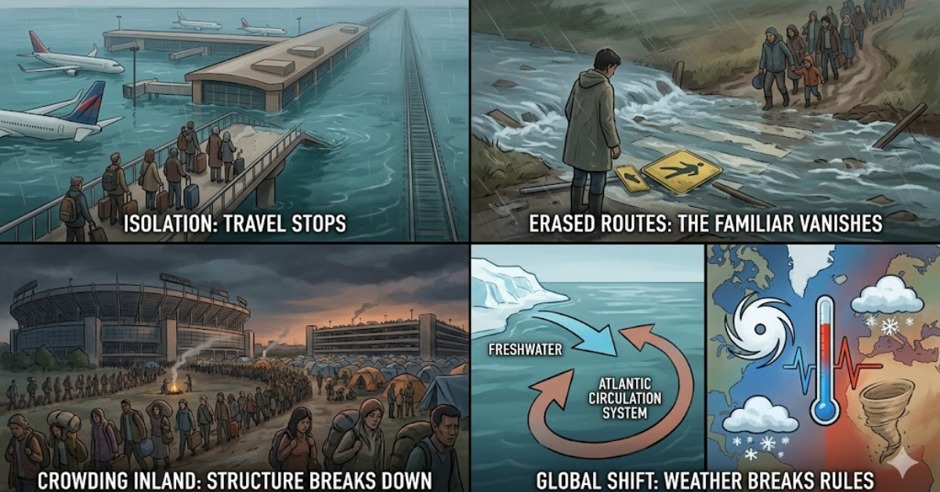
By the second day, movement becomes harder everywhere. Airports sit partly submerged, train tracks vanish beneath rising tides, and evacuation routes narrow faster than people can move through them. You watch someone stop at a familiar crossing that no longer exists, their usual route erased within hours.
As coastlines disappear, millions of people begin moving inland together. Hotels fill first. Then, schools, stadiums, parking garages, and any structure capable of holding large groups. Entire regions lose the structure that once kept daily life organised, and the idea of simply relocating feels less realistic with every passing hour.
At the same time, another shift unfolds far beyond the flooded streets. Freshwater from melting ice starts mixing into the oceans, and studies suggest this could weaken major currents, such as the Atlantic circulation system. You may not see those currents directly, but you notice the effects around you. Temperatures swing unpredictably, storms arrive out of season, and weather patterns stop behaving the way people expect.
The uncertainty spreads faster than the water itself, pushing attention toward changes that were invisible only a day earlier.
Day Three: Ice Withdraws
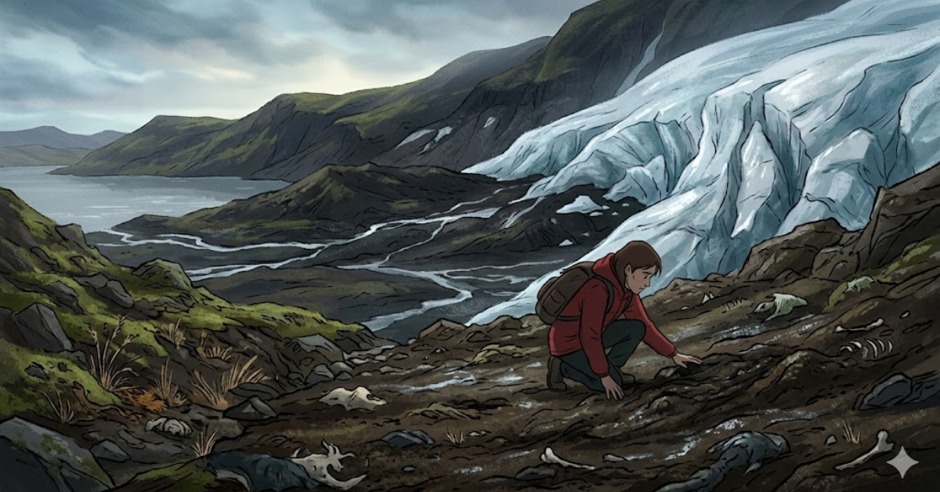
By the third day, glaciers retreat fast enough to expose land untouched for centuries. Hillsides emerge uneven and dark, carrying textures no one alive has ever seen directly. You crouch down and touch soil that still feels cold from the ice that covered it only days before, unsure whether the moment feels more like discovery or loss.
Research shows that melting ice can uncover ancient microbial life, and that knowledge changes how the landscape feels around you. The ground is not simply new terrain. It contains traces of environments sealed away long before modern civilization existed.
In some regions, preserved animal remains emerge as permafrost thaws. In others, long-buried plant life reappears beneath collapsing ice sheets. What had once seemed permanent now looks temporary, and the pace of those discoveries continues to accelerate as more frozen ground softens.
At the same time, the thaw continues deeper below the surface.
Day Four: Changes Below the Surface
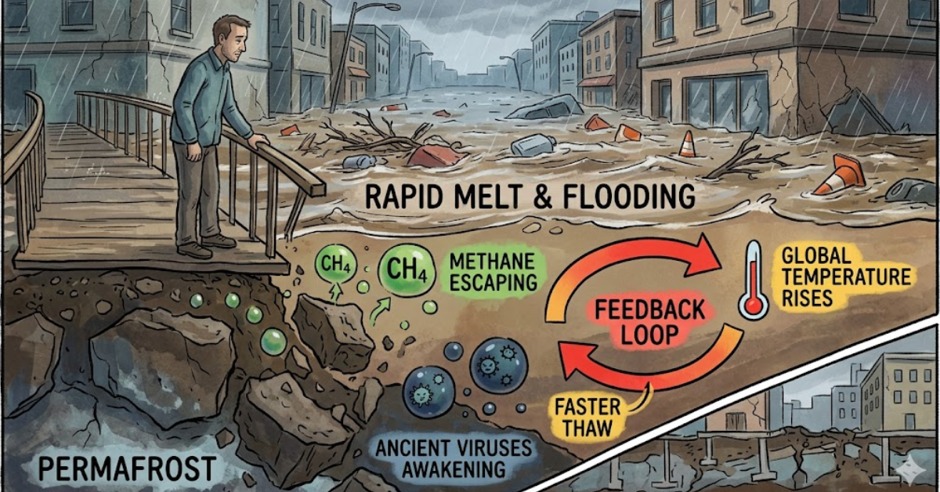
By the fourth day, the melting no longer stops with glaciers or snowcaps. Deep underground, permafrost that remained frozen for thousands of years starts to soften rapidly. Scientists have already revived ancient viruses from frozen environments, proving that some forms of microscopic life can survive far longer than once believed.
You pause beside a railing, watching floodwater carry debris through the street, while another concern takes shape beyond what you can actually see. The danger is not dramatic or immediate. It builds gradually through uncertainty, limited research, and a growing awareness that frozen ground was storing more than ice alone.
As temperatures continue to rise, methane trapped inside permafrost also escapes into the atmosphere. That matters because methane holds far more heat than carbon dioxide over shorter periods, meaning the warming process starts feeding into itself. The hotter the planet becomes, the faster remaining frozen ground breaks apart.
And by now, those changes are no longer confined to the environment.
Day Five and Six: Systems Under Pressure
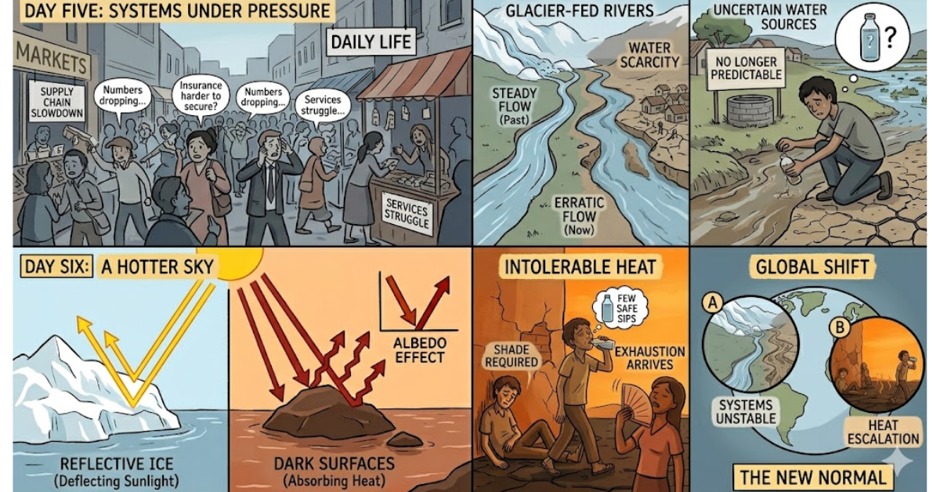
By the fifth day, the pressure reaches the systems people depend on daily. Markets react quickly, though not smoothly. You overhear fragments of conversation, numbers dropping, uncertainty spreading through decisions that once felt routine. Insurance becomes harder to secure. Supply chains slow down, and services built around stable infrastructure struggle to adapt.
At the same time, water surrounds you more than ever, yet clean drinking water becomes less dependable. Rivers fed by glaciers lose the steady meltwater that once regulated their flow. Some regions flood repeatedly, while others face shortages because their freshwater sources no longer behave predictably.
You lift a bottle and notice how carefully you measure each sip. The irony settles in slowly: water is everywhere, yet very little of it feels safe to depend on anymore.
By the sixth day, another change becomes impossible to ignore. Without bright ice reflecting sunlight into space, darker surfaces absorb more heat. At first, the warmth feels subtle, like a summer afternoon stretching longer than expected, but over time, it grows harder to tolerate. You search for shade more often, move more slowly, and notice how quickly exhaustion arrives beneath a hotter sky.
Day Seven: A New Baseline Forms
By the end of the week, the world no longer feels like it is collapsing all at once. Instead, it feels like everything is continuously adjusting, one change pushing naturally into the next. Water reshapes land, land reshapes movement, and movement reshapes how people think about distance, safety, and survival.
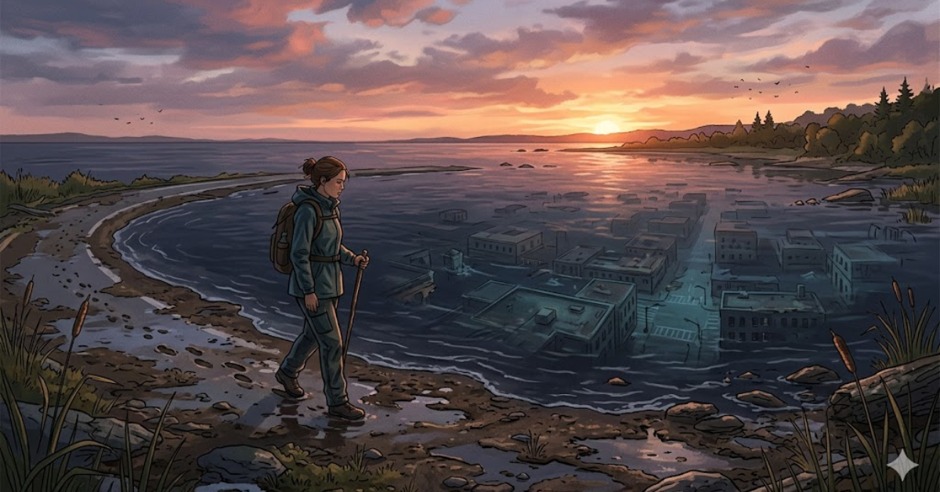
You walk along what used to be a familiar route, now bordering a new stretch of water, and stop for a moment. Beneath the surface, the outlines of buildings remain faintly visible, familiar in the same way old memories linger long after circumstances change around them. That image stays with you because it captures something larger than flooding alone. A world that once felt stable now looks more temporary than anyone expected.
And as you turn back, one final thought settles into place: if a system this large can change within a single week, then perhaps stability was never permanence at all, but a balance that lasted long enough to feel permanent.
Sources
The following sources were consulted while writing “What If All the Ice on Earth Melted in Seven Days?”
- Scientists revive 48,500-year-old virus, setting world record
https://www.smithsonianmag.com/smart-news/scientists-revive-48500-year-old-virus-setting-world-record-180981208/ - Permafrost and the global carbon cycle
https://arctic.noaa.gov/report-card/report-card-2019/permafrost-and-the-global-carbon-cycle/ - What would happen if all the ice on Earth melted?
https://www.yourweather.co.uk/news/science/what-would-happen-if-all-ice-on-earth-melted-climate-change.html - Feature article: Is the Atlantic overturning circulation approaching a tipping point?
https://tos.org/oceanography/article/is-the-atlantic-overturning-circulation-approaching-a-tipping-point - What if all the ice melted on Earth? ft. Bill Nye
https://www.youtube.com/watch?v=b6CPsGanO_U - The images in this blog are created with the support of an AI tool and reviewed by the author.




Comments