

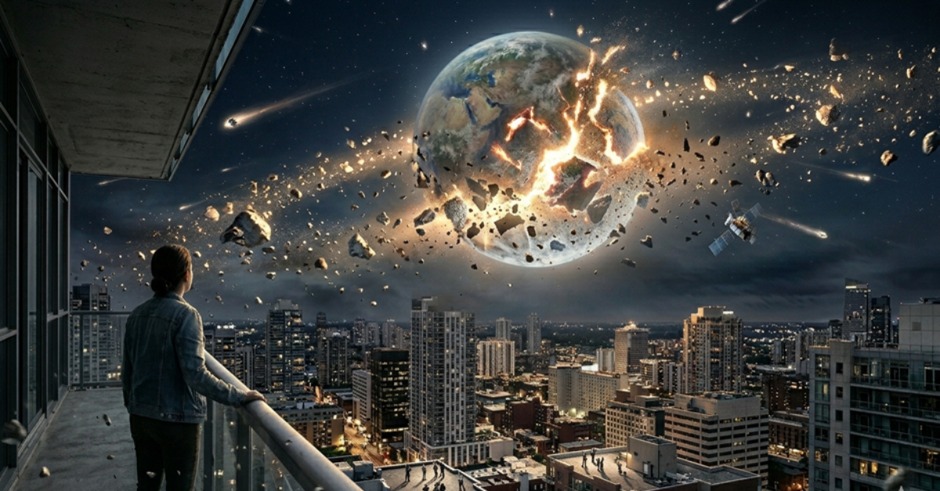
What happens if the Moon explodes tonight? Discover how tides, sleep, seasons, and daily life unravel within hours in this immersive science exploration.
You step onto your balcony as night settles over the city, the air carrying a faint chill and the steady hum of traffic below. Above you, the Moon sits in its usual place, pale and unhurried, casting a soft wash of silver across the rooftops.
It feels like a presence that has never moved and shows no sign of moving.
Which is precisely why the question, once it forms, is difficult to set aside: what happens if it explodes tonight?
Held in Place
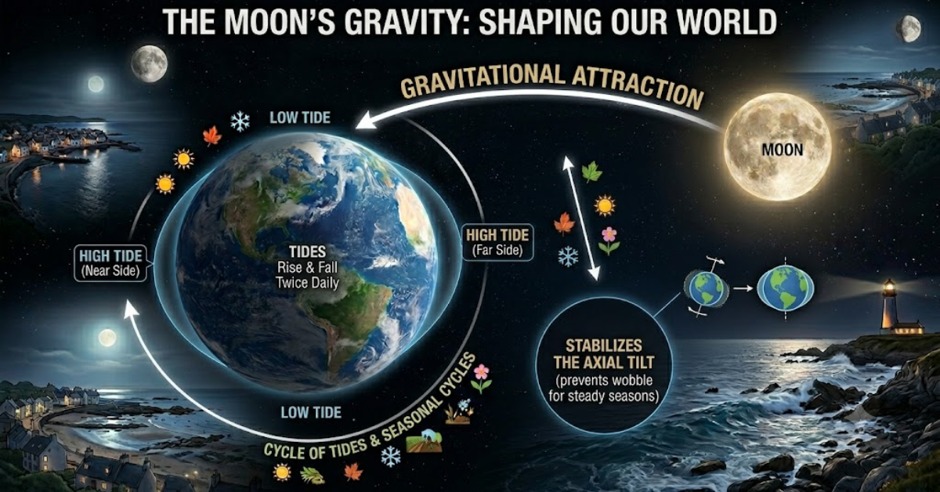
That pale light is doing far more than lighting the street below. According to NASA’s lunar research, the Moon’s gravity pulls on Earth’s oceans in a slow, continuous rhythm, shaping the tides that rise and fall twice a day along every coastline; its gravity also holds Earth’s axial tilt steady, keeping seasons returning in the order every living thing has arranged itself around.
Two invisible forces, working in unbroken silence and entirely indifferent to how much depends on their stability. You rest your forearms on the cool railing, the city below continuing unaware of what keeps it this way, and tonight, for the first time, you wonder what happens when an anchor this permanent suddenly stops.
The Light Changes
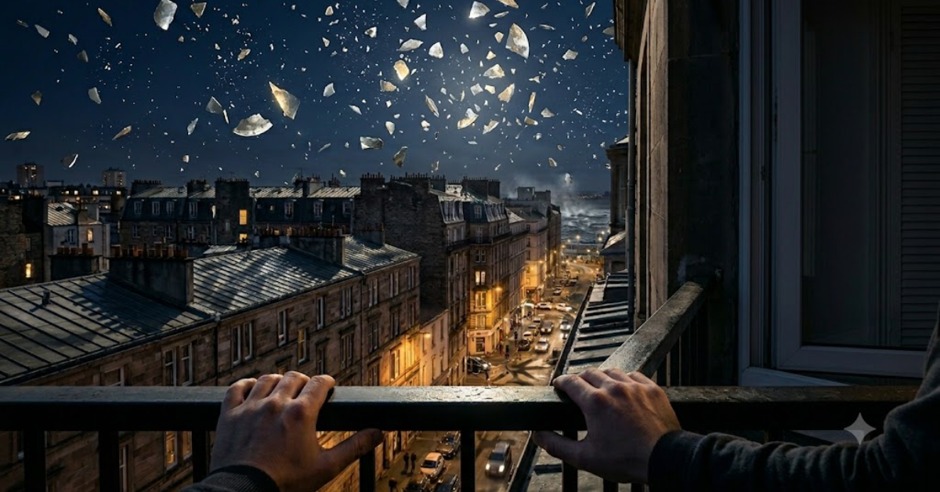
The aftermath arrives before the sound ever can. The explosion reaches you as light ahead of anything else: sound has no path across the silence of space, and so the shattered Moon simply comes apart in front of you, every fragment catching sunlight, every one beginning to drift along its own separate path through the dark.
With the fragments spreading, the light from above changes too, arriving from several directions at once rather than from a single familiar source, casting shadows that contradict one another across the rooftops.
That contradiction reaches the body before the mind catches up with it. You glance down at your own shadow and find three of them stretching across the balcony floor in different directions. For a moment, your eyes move between them, trying to decide which one belongs to the light source you had been looking at only seconds earlier. Your breathing slows, not from exertion, but from the simple effort of making sense of what you are seeing. Your hands find the railing without instruction, pressing into the cool metal as the sky continues to produce effects it never has before.
Within the first hour, that disorientation begins pressing into everything around you, and the effects are already reaching the shoreline.
The Water Shifts
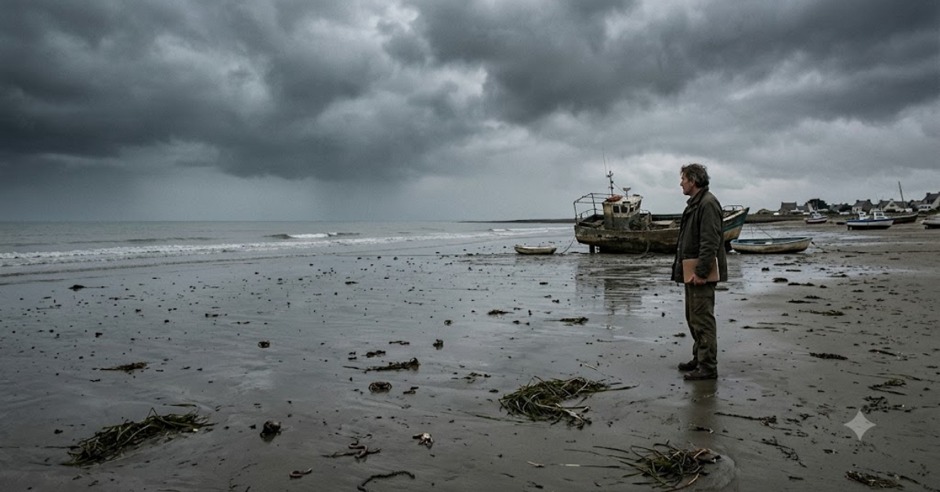
Deprived of the Moon’s gravitational pull, tidal range drops by roughly two-thirds almost immediately. The National Oceanic and Atmospheric Administration has documented how coastal ecosystems are built entirely around tidal predictability; stripped of that rhythm, coastlines that normally breathe with the daily rise and fall of water grow unnervingly still.
If you are standing at the edge of the sea, you hear it ahead of seeing it: waves arriving with less force, the salt air thinner, the sand shifting less beneath your feet. A foreign stillness settles, and the wildlife along the shore feels the same loss just as quickly, rhythms calibrated across millions of years suddenly finding nothing to follow.
By morning, every harbour and tidal flat on the planet is still in a way it has never been. And as the shoreline settles into that unfamiliar stillness, the sky above begins to alter.
Debris Overhead
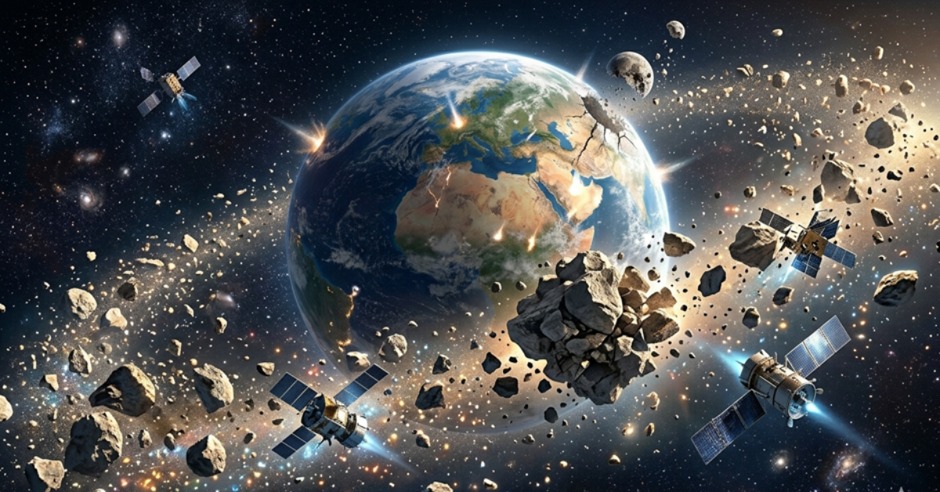
Looming over the quiet world, the fractured remnants of the Moon are already shifting into their new alignment.
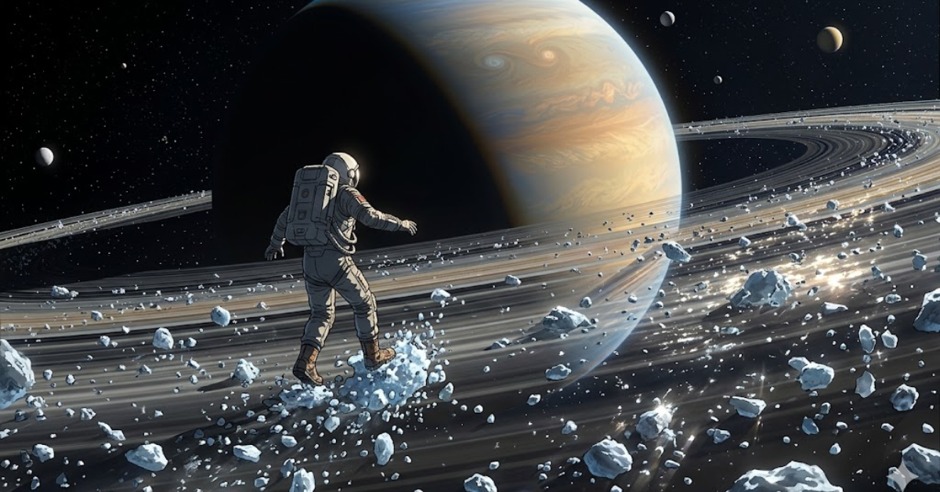
At first, it is subtle: a streak of light at the wrong angle, lasting a fraction too long, then another, then dozens at once. Those streaks are the visible edge of a far larger ruin: lunar fragments ranging from fine dust to objects the size of mountains settle into orbits around Earth, smaller pieces colliding and breaking apart, spreading into an unplanned ring that churns rather than holds.
Then sonic booms follow as the lowest fragments shear through the upper atmosphere: low formless pressure rolls across the horizon, moving through the ground and into your feet and ribs before your ears have registered anything at all.
In the gap between one boom and the next, you notice the screen in your pocket has gone dark. The European Space Agency has long studied how cascading orbital debris can disable satellites within hours; that silence from the screen confirms what is already visible above, and carries its own specific weight. Even then, as the sky unravels throughout that first night, the realisation of what we have lost is already settling into the body.
The Body Notices
By the second night, that initial shock gives way to a deeper, biological disorientation. Research published by the National Institutes of Health has shown that human sleep patterns are calibrated to lunar light, shaped over millions of years. With that light now fragmented and irregular, you wake at the wrong hour and lie in the dark, the air carrying a staleness that no open window shifts.
The tiredness is different from ordinary fatigue: it sits behind your eyes, slowing your decisions and making simple tasks feel further away than they should. You reach for a word mid-sentence and find it gone.
By the fourth day, that fog is visible to everyone around you. Conversations shorten; patience thins; and the small exchanges that hold ordinary life together start requiring more effort than they ever have.
This toll accumulates quietly, settling into the population the way sustained pressure always does, arriving so gradually that nobody can name the moment it begins. And when enough people are running that close to empty, the systems they operate begin to show it, too.
The Long Consequence
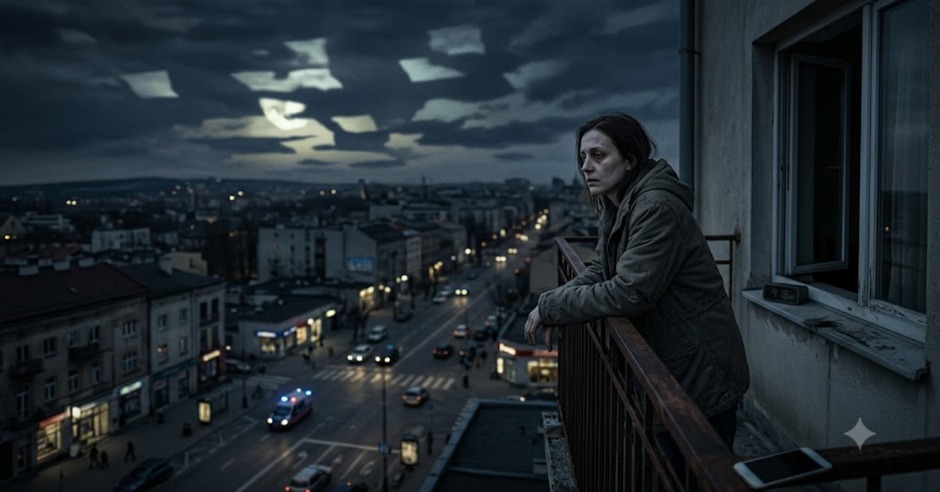
By the end of the first week, that exhaustion has pressed into every system the city depends on: emergency services managing disrupted schedules, hospitals reporting irregular patterns, and supply chains absorbing delays nobody can trace to a single source. The city is still functioning, but the underlying pulse of daily life has been quietly replaced by a caution no one has chosen.
Yet the unravelling does not stop at the city limits. Beneath that surface, a far slower, planetary process is already in motion.
Without the Moon holding Earth’s axial tilt in place, seasons begin arriving out of order, winters deepen in places unprepared for them, and summers shorten in regions built entirely around their length. NASA’s planetary science research confirms that even modest axial shifts trigger cascading climate changes across geological timescales, and the landscapes and entire civilisations that have arranged themselves around old stability gradually become unrecognisable.
You do not live to see any of it. But standing on that balcony, feeling the altered air against your skin and hearing the silence where your phone used to hum, you are already standing inside its earliest moment, your body registering what the mind has not yet named.
Still There
You look up, and the Moon is whole, sitting exactly where it always has. The chill on your arms is unchanged, the traffic below moves through its predictable sounds, and nothing has shifted tonight.
But the light across the rooftops reads differently now.
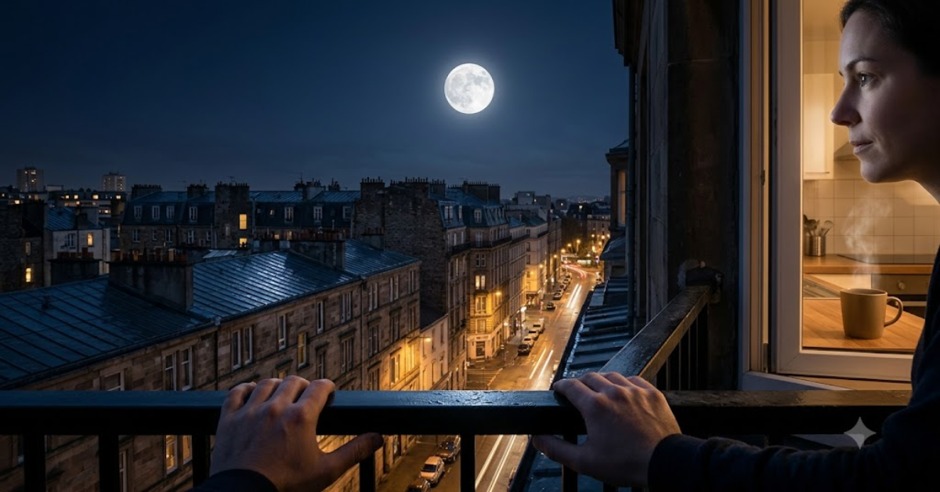
You stay a moment longer than you planned, your hands on the railing, the cool metal solid under your palms. The silver wash looks similar, and yet you are looking at it with more attention than before: noticing what it does each night, tracking the quiet work it performs, registering, for the first time, how much depends on that continuity remaining uninterrupted.
You go back inside, and the sounds of the apartment settle around you. You set your hands around a warm cup in the kitchen, feeling the heat against your palms, and the ordinary weight of the moment feels steadier than it did before you stepped outside.
The Moon above the city looks exactly as it always has. Yet you are simply paying attention to it differently now.
Sources
The following sources were consulted while writing “What Happens If the Moon Explodes Tonight?”
- The World without the Moon
https://www.scientificamerican.com/blog/life-unbounded/the-world-without-the-moon/ - Lunar synergy: the impact of Moon phases on Earth, plants, and humans
https://www.academia.edu/126921374/Lunar_Synergy_The_Impact_of_Moon_Phases_on_Earth_Plants_and_Humans - Moon mysteries
https://topdocumentaryfilms.com/moon-mysteries/ - What causes the seasons?
https://spaceplace.nasa.gov/seasons/en/ - Moonstruck sleep: synchronisation of human sleep with the moon cycle under field conditions
https://pmc.ncbi.nlm.nih.gov/articles/PMC7840136/ - The images in this blog are created with the support of an AI tool and reviewed by the author.


Comments