

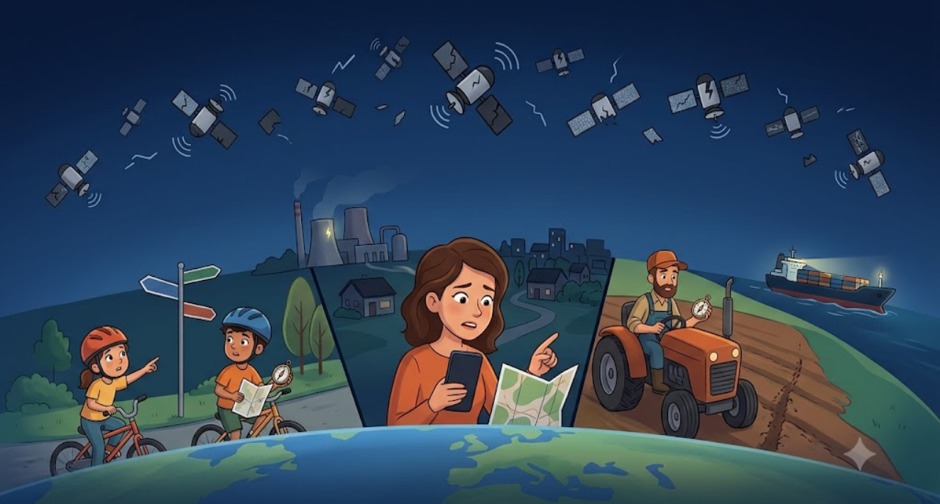
What happens if satellites suddenly stop working across Earth? Navigation fails, systems slow, and daily life reshapes as unseen signals quietly disappear.
Have you ever wondered why your phone always knows exactly where that taco truck is, even when it feels out of sight? You look at the screen, follow the small blue arrow, and trust it without thinking much.
That quiet certainty comes from satellites far above you, constantly sending signals that guide your route, track weather, and keep systems working in the background in ways you rarely notice.
Signal Loss
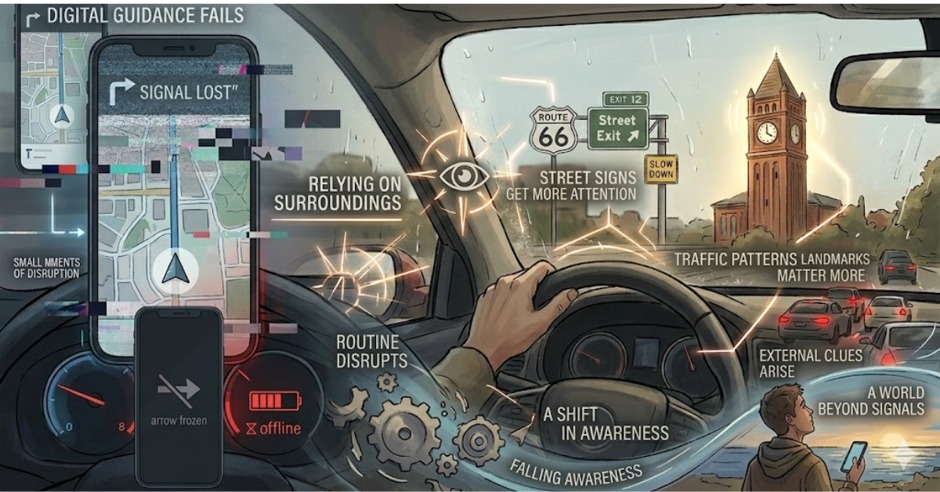
Now imagine that signal slowly fading. The map stops updating, the arrow freezes, and for a moment, you expect it to fix itself, but it does not.
That pause draws your attention in a little more sharply. Without digital guidance, your eyes begin scanning the road, looking for clues you normally ignore.
If directions and alerts suddenly disappeared, what do you rely on instead?
At first, the change feels very small. Street signs get more attention, buildings become points of reference, and traffic patterns start to feel more important. Things that once faded into the background now stand out more clearly, slowly showing how much of your routine depends on signals you do not see.
If everything stopped at once, the disruption would not happen as a single event. It would unfold through small moments that no longer behave as expected.
Navigation Breaks
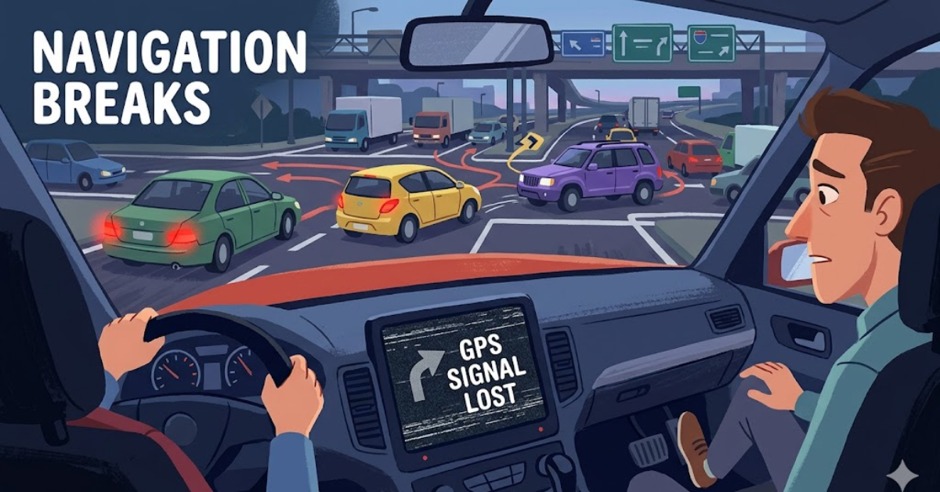
Let us start with navigation. You are in the middle of your commute when your GPS suddenly stops working. The route disappears, and the blue arrow that once felt reliable now leaves you unsure. You ease off the accelerator, eyes moving between roads, and the new route feels less certain with every intersection.
Around you, the same confusion spreads. One driver slows too early, another misses a turn, and movement starts to lose its usual flow.
Communication Fades
As navigation grows uncertain, communication weakens with it.
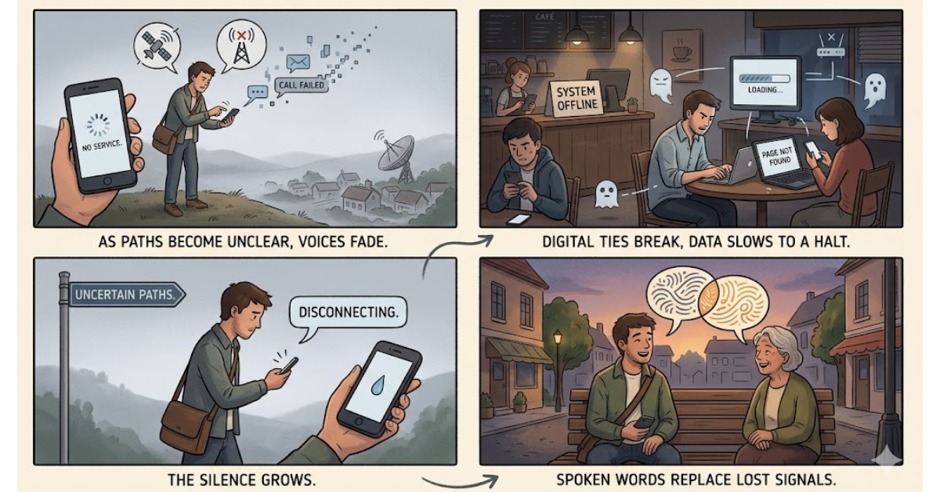
Connections start to drop. Satellite TV cuts out, internet slows, and calls fail in places that once felt stable. You tap your phone again, hold it toward the window, then lower it when nothing changes.
Without updates arriving on their own, conversation fills the gap messages used to hold. A short exchange with someone standing beside you suddenly feels more direct than anything typed, and that shift is impossible to miss.
Global Strain Begins
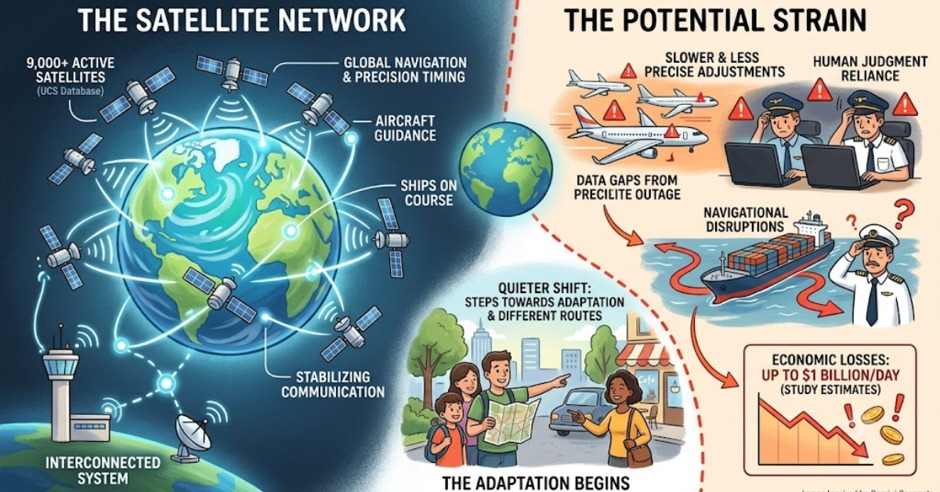
The scale behind this becomes harder to ignore. More than 9,000 active satellites circle Earth, according to the UCS Satellite Database, quietly guiding aircraft, holding communication steady, and keeping financial systems synced to fractions of a second. None of that is visible from where you stand, yet its absence is.
Aircraft depend on satellite positioning to hold their course, and ships rely on it the same way. Without those signals, every adjustment slows and leans harder on human judgment instead of certainty.
According to various studies, even a short GPS outage could cost up to one billion dollars a day in delays alone. You step outside and ask a stranger for directions, something you have not done in years, and the small exchange leaves you oddly steadier.
Timing Breaks Down
That uncertainty extends into systems that depend on exact timing.
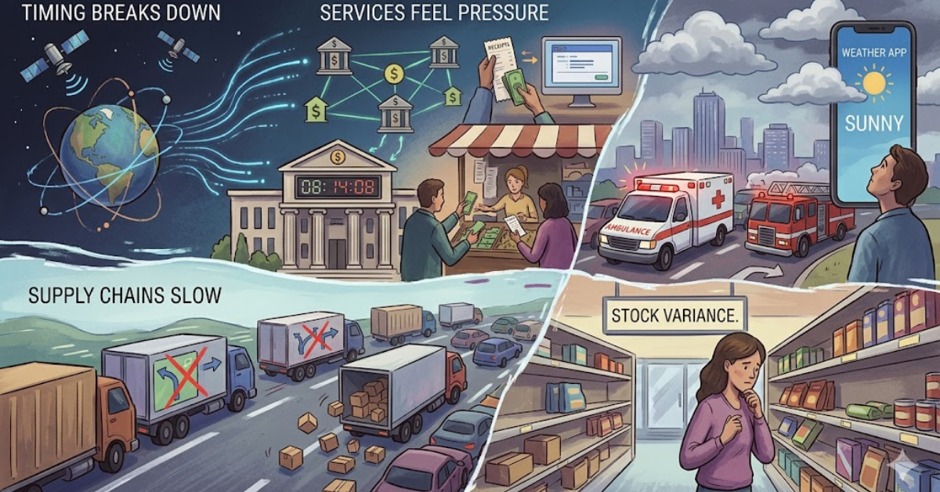
Financial networks rely on satellite signals to match transactions, and without them, timing starts to drift. You do not see the drift directly, only its effects: slower responses, delayed confirmations, systems that used to feel instant now hesitating.
You reach for cash instead of a card, and the weight of it in your palm feels more dependable than any number on a screen.
Services and Supply Chains Slow
Moreover, emergency services feel that same pressure. Routes grow less predictable, response times stretch longer, and weather alerts show clear skies while clouds gather overhead.
You step outside and look up instead of checking your phone. That single act of watching the sky yourself, rather than trusting a feed, changes how carefully you start paying attention to everything else.
As time passes, the disruption spreads outward. Deliveries fall out of sync as navigation systems lose the precision they once relied on, and small delays compound into larger ones.
You walk into a store and linger longer than usual at half-empty shelves. Nothing is gone entirely, but the gaps are enough to notice, and that small uncertainty follows you down every aisle.
Local Life Grows
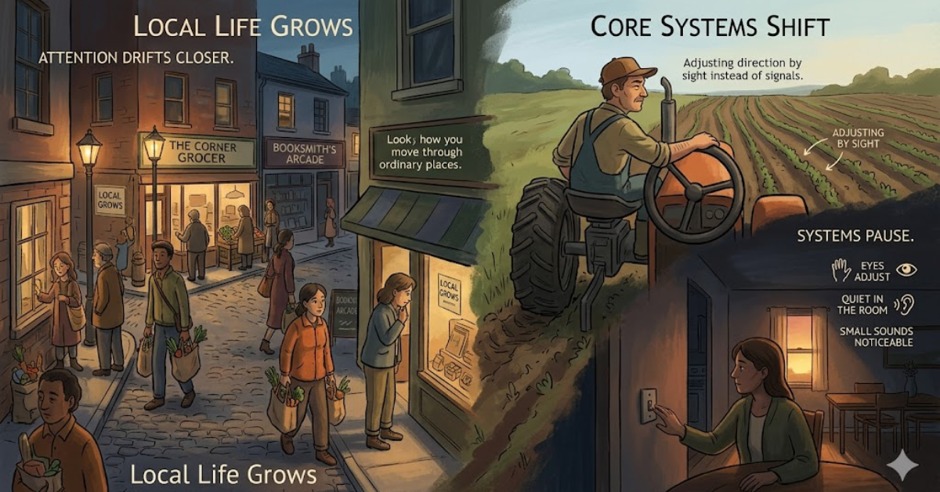
The change settles in quietly. Attention narrows toward what sits close: the corner store, the bakery two streets over, a neighbour who still answers a landline.
You walk into these places more often now, not by choice but by necessity, since distance has become a cost you can no longer absorb without thinking. The cashier recognises your face before you reach the counter, and that small recognition holds more weight than convenience ever did.
Core Systems Shift
From there, the impact reaches the ground itself.
Agriculture depends heavily on satellite guidance. Without it, tractors lose precision, planting patterns shift, and large fields become harder to manage. A farmer pauses at the edge of a field, hand resting on the wheel, looking at rows that no longer line up properly, adjusting direction by sight instead of signals. Over time, this becomes normal, and experience replaces technology.
Although that slower, hands-on approach feels different, it becomes steady, and the same change appears in other systems, too.
Energy systems follow a similar pattern. Power grids depend on precise timing to stay stable, and without it, small issues begin to appear. Lights flicker, systems pause, and routines are interrupted without warning.
You sit in that moment, your hand still near a switch that no longer responds. Without constant light, you notice the quiet in the room, the shapes of objects, and how your eyes slowly adjust.
As the silence settles, you begin to notice small sounds you usually ignore, and that awareness makes the missing systems easier to feel.
Global Awareness Slows
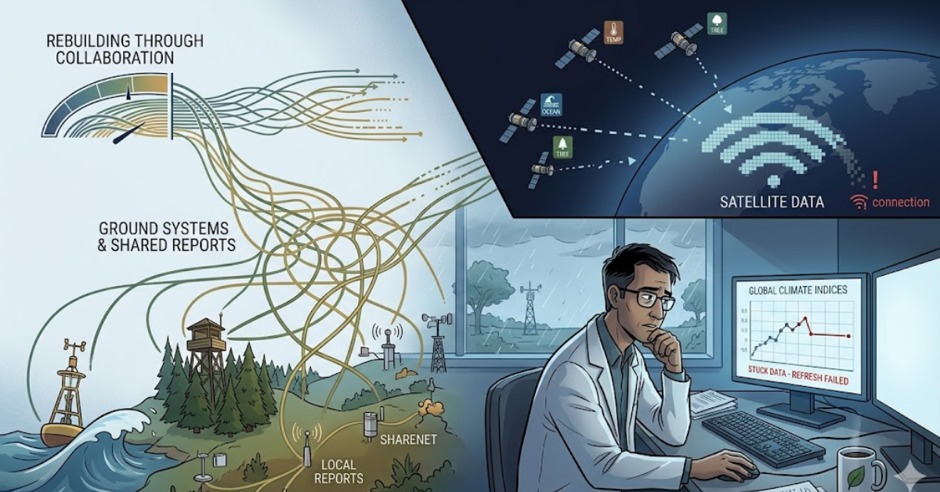
Scientific monitoring slows down. Satellites track climate, oceans, and environmental changes, and without them, that flow of information becomes thinner. Somewhere, a researcher refreshes a screen out of habit, only to see the data stuck where it used to move smoothly.
That gap does not stay empty for long. Ground systems, shared reports, and other methods slowly begin to fill in, rebuilding what was lost from another direction.
Unlikely Collapse
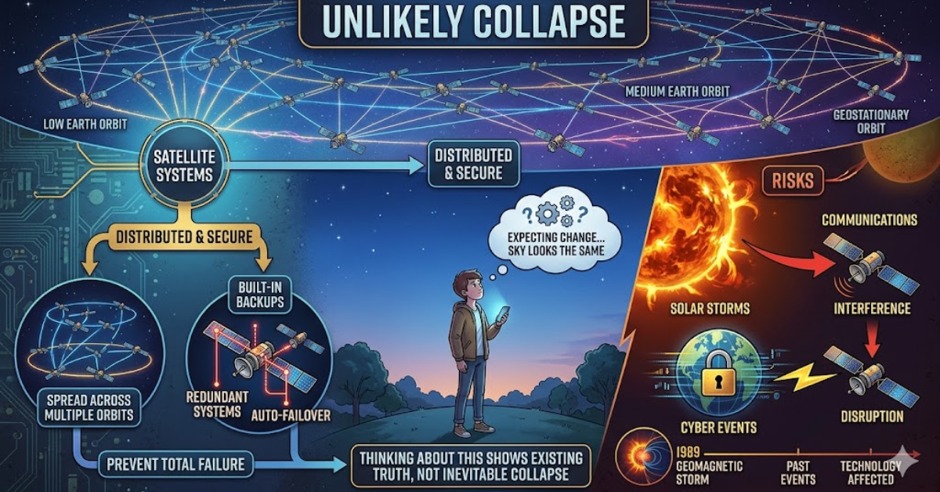
However, a full satellite shutdown is very unlikely because systems are spread across different orbits and have built-in backups to prevent total failure. You look up for a moment, expecting something to feel different, but the sky looks the same.
Even so, risks still exist. Solar storms and cyber events show that the system is not completely safe from disruption. Past events, like the 1989 geomagnetic storm, show how quickly technology can be affected when conditions change.
Thinking about this scenario does not mean collapse will happen. Instead, it shows something already true.
Before Satellites
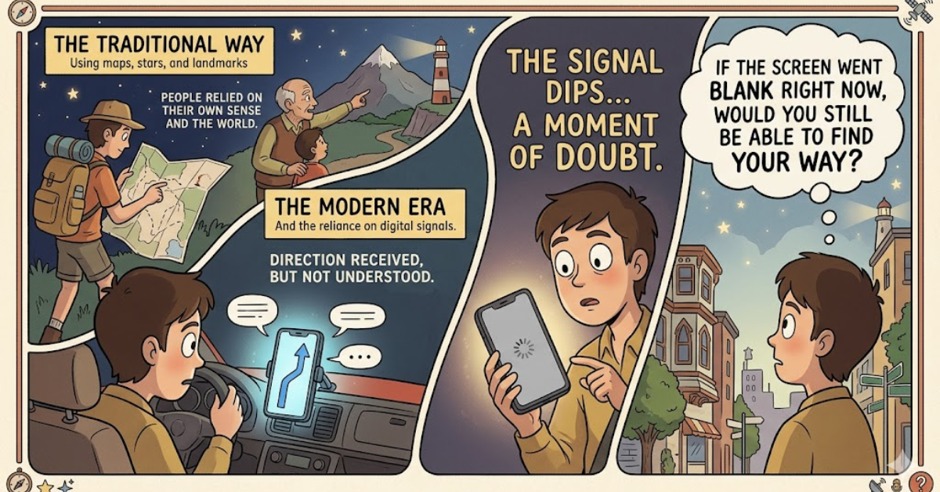
Before satellites existed, people used maps, landmarks, and stars to find their way. Those methods still exist, but they are used less often now.
Instead of scrolling a map on your phone and following directions, you find yourself unfolding a paper map, tracing routes with your finger, and connecting paths. At first, it feels unfamiliar, then slowly becomes clear.
That process changes how you move. Direction becomes something you understand, not just an instruction you receive, and that awareness slowly settles into your routine. As it does, a quieter thought begins to form.
Looking Up Again
Even as life begins adjusting and learning to rely on simpler methods again, modern tools still return to your hand as if nothing changed. The route appears, the arrow moves, and each turn shows up on time.
But this time, there is a slight pause before following it. A small awareness stays in the background.
Because if that signal ever disappears, even for a short time, the only thing left to guide you will be your own sense of direction.
So, before you rely on it again, take a moment to look around, instead of just looking at the screen. Notice the roads, the buildings, and the small details that usually pass unnoticed.
Then ask yourself one simple question. If the screen went blank right now, would you still be able to find your way?
Sources
The following sources were consulted while writing “What Happens If All Satellites Suddenly Stop Working?”
- The economic impact of a loss of satcom
https://www.esa.int/Applications/Connectivity_and_Secure_Communications/What_would_happen_without_satellite_communications - The economic power of GPS technology
https://www.economyinsights.com/p/the-economic-power-of-gps-technology - Navigating the unknown: the high-stakes risks of GNSS outages in an era of conflict, logistics, and digital economy
https://starburst.aero/news/navigating-the-unknown-the-risks-of-gnss-outages/ - A 21st-century view of the March 1989 magnetic storm
https://agupubs.onlinelibrary.wiley.com/doi/full/10.1029/2019SW002278 - The images in this blog are created with the support of an AI tool and reviewed by the author.





Comments