

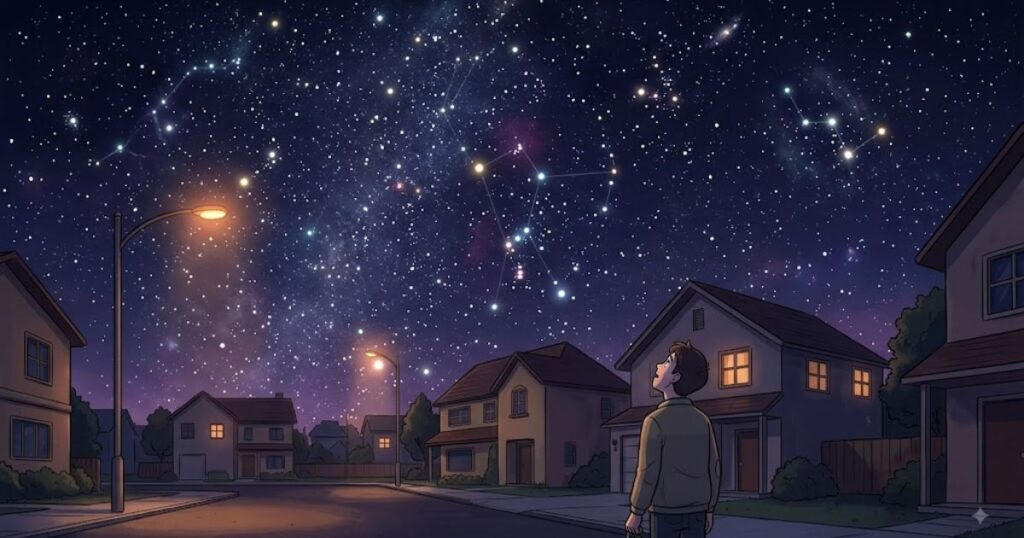
What if you could see 10 times more stars every night? Explore darker skies, light pollution, moonlight, and how much more of the night sky your eyes can reveal.
You step outside just after dinner, the cool evening air resting against your arms as the door closes behind you. You glance upward before heading back in, expecting the few bright stars you normally notice above the rooftops.
Instead, your eyes catch far more points of light than usual. You blink once, then again, waiting for them to settle into the familiar darkness.
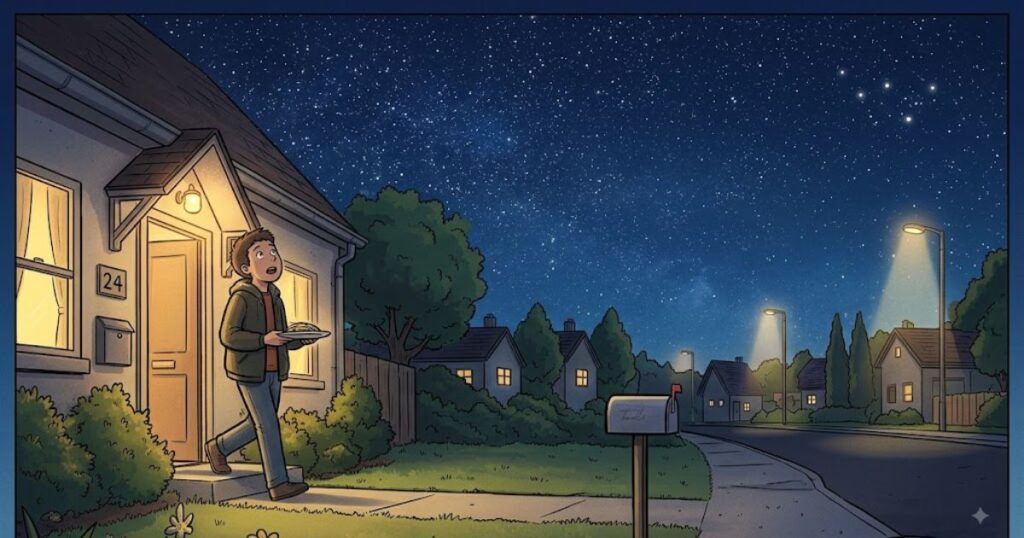
Orion is still easy to identify by its belt, but the stars around it make the constellation less distinct. Cassiopeia’s W is there too, although it no longer stands apart from the surrounding sky.
Nothing on the ground has changed. The same houses and streetlights are around you, yet the sky above them now holds roughly ten times as many visible stars. You keep looking, letting your eyes take in the crowded view, and one question follows naturally: What if you could see much of the night sky every night?
Testing the Night Sky again
The next evening, you return to the same place to see whether the view looks the same.
At first, everything is where you remember it: the rooftops, streetlights, and darker gaps between the houses.
Near the brighter streetlight, some faint stars fade from view. As you move into the darker surroundings, a few return, followed by others that gradually stand out. You pause there, noticing how the same patch of sky looks different with less brightness around you.
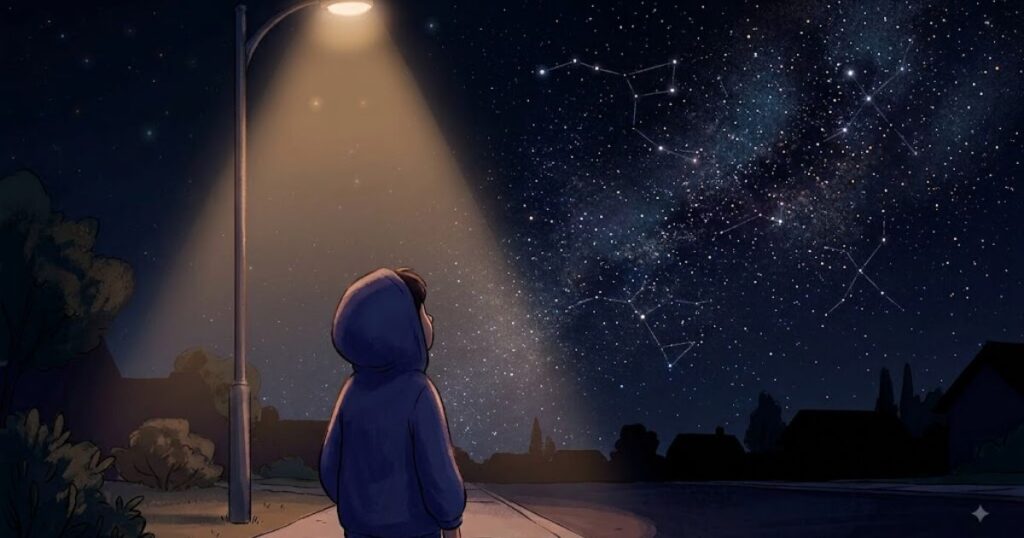
The difference is striking when you compare what different skies allow you to see. Sky & Telescope estimates about 900 naked-eye stars across the entire sky under suburban conditions, or roughly half that from one location. In a bright city sky, the number can fall to about 35, while a very dark sky can reveal roughly 4,548 stars above the horizon at one time.
With that in mind, you begin learning how to read this fuller sky.
A Few Nights Later: Exploring the Night Sky
Orion is the first constellation you follow, tracing its shape from Betelgeuse toward Rigel while keeping the surrounding stars in view.
The main stars remain easy to locate, but dozens of dimmer ones surround them. You follow the pattern, lose it among the extra points, then trace it again more slowly, your neck tilting back as you stay with it.
Cassiopeia comes next. Its five main stars still form the W you know, yet the denser background makes the shape take longer to pick out.
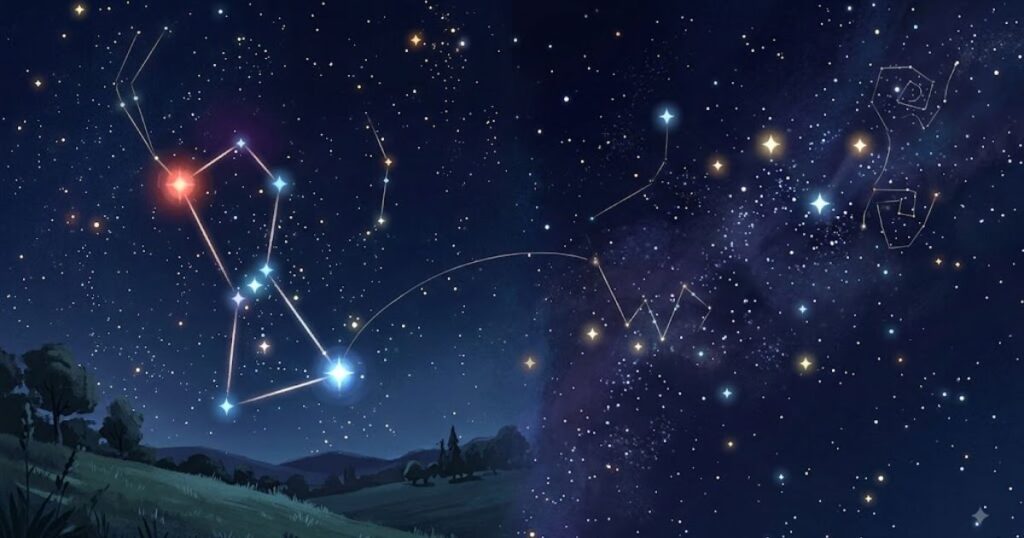
You move on to another constellation, then another, finding the same thing each time. The patterns have not changed; there are simply more points of light around them. As you learn those surrounding points, the crowded sky gradually becomes easier to read, and you start noticing another change: the same sky does not appear in exactly the same place each night.
One Week Later: Orion’s Changing Position
By now, looking up has become part of your evening routine. While following Orion through the denser sky, you compare its position with the rooftops and begin noticing that the constellation does not return to exactly the same place at the same clock time.
When you check again on another night, Orion is slightly farther along than before. The difference is small, but after several comparisons, the shift becomes easier to follow, giving you another part of the sky to keep track of.
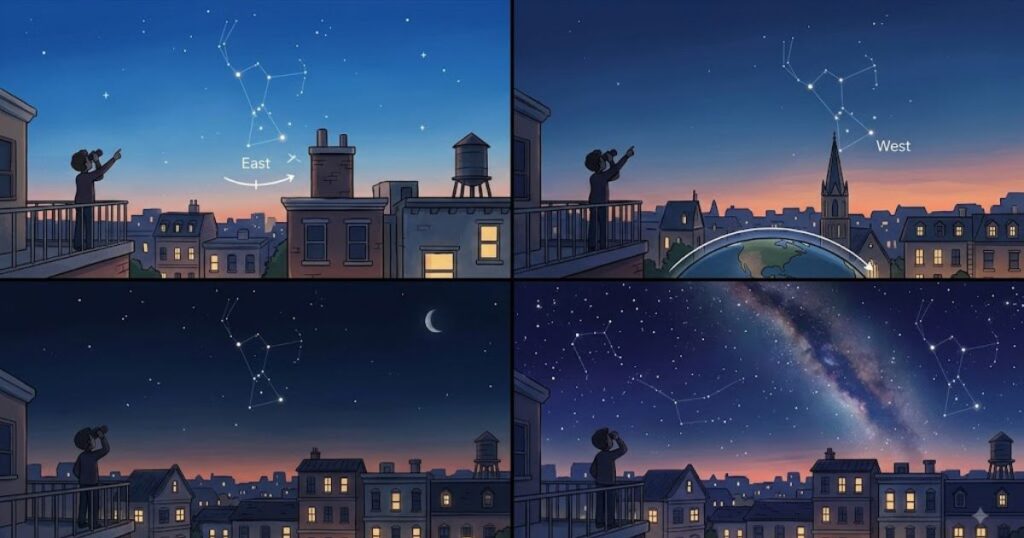
The timing has a reason. Orion rises about four minutes earlier each night because a sidereal day is about four minutes shorter than the 24-hour solar day, and this difference is due to Earth’s rotation relative to the distant stars.
So, as you keep returning to the same patch of sky, you are learning not only where Orion appears, but also how its position changes from night to night. Eventually, another change gives you a different view to compare.
One Month Later: Moonlight Changes the View
The change arrives with the full Moon above Orion. You can still pick out the constellation by its familiar shape, but several of the faint surrounding details are harder to separate than they were on darker nights.
When you return to the same part of the sky on a moonless night, those faint points come back into view. The difference is tied to how bright the night sky is and how well your eyes have adapted to it. Moonlight, like artificial light, raises the background brightness, while EarthSky notes that your eyes can take up to about 30 minutes to adapt fully to darkness.
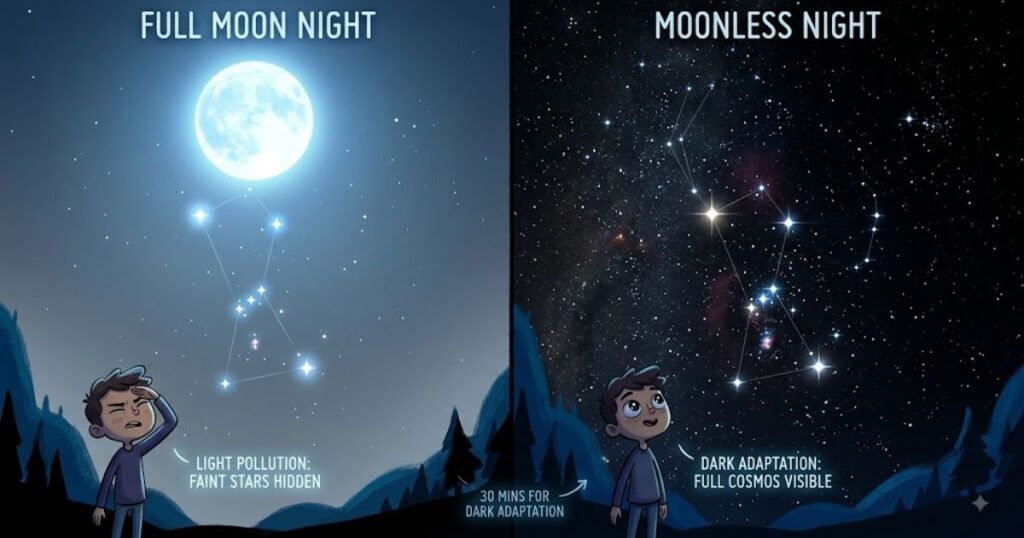
Once you start noticing that effect, you pay more attention to what appears after your eyes have had time to adjust. On a darker night, the faint points around Orion hold your attention longer, and gradually your view extends beyond the familiar constellation.
Months Later: The Milky Way Appears
That wider view eventually takes you beyond individual stars and constellations. You raise your binoculars toward Orion, and stars that your eyes cannot separate fill the view.
When you lower them, your dark-adapted eyes pick up a broad band across the sky: the Milky Way, whose countless distant stars appear blended together rather than individually resolved to the naked eye.
You raise the binoculars again, and the focus wheel clicks beneath your fingers as the view sharpens. Through 50-millimetre binoculars, you can potentially see around 217,000 stars across the sky, while a three-inch telescope can reach about 5.3 million, according to Sky & Telescope, far beyond what your eyes can distinguish unaided.
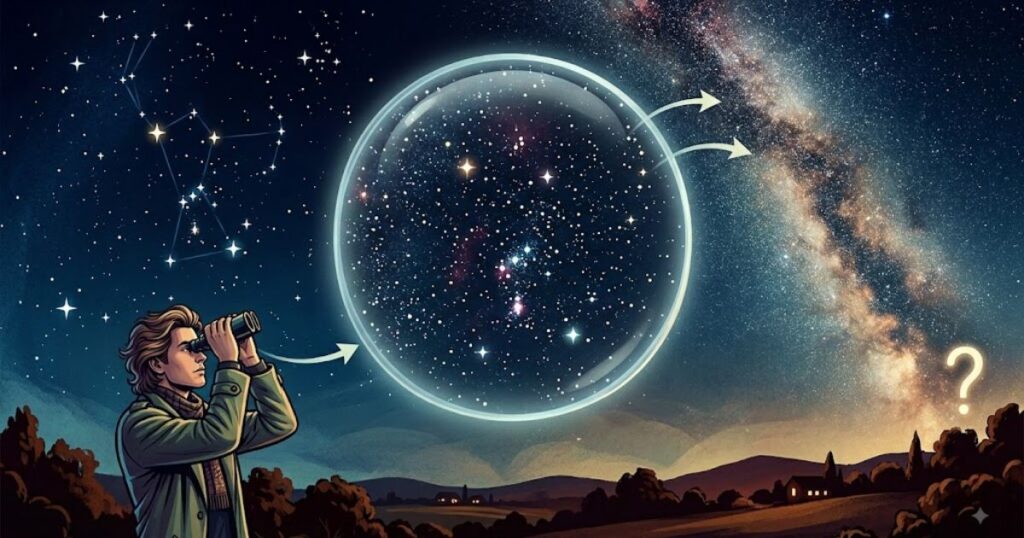
You lower the binoculars and return to the sky with your own eyes. The view is fuller than before, yet you can still see that your unaided eyes have their limits. Looking back at Orion, you now have a familiar pattern against which to compare what different skies can reveal.
Reality Check: The Stars Were Already There
You keep your eyes on Orion, comparing the stars around its familiar shape with what you have seen on darker nights. CPRE’s Star Count shows just how much those conditions can change the view: fewer than 10 visible stars in Orion indicate severe light pollution, while more than 30 can be seen under genuinely dark skies.
The same effect has already appeared in your own observations. Moonlight and surrounding darkness change how many faint points stand out, not because stars are appearing or disappearing, but because their light is easier or harder for your eyes to separate from the brightness around you.
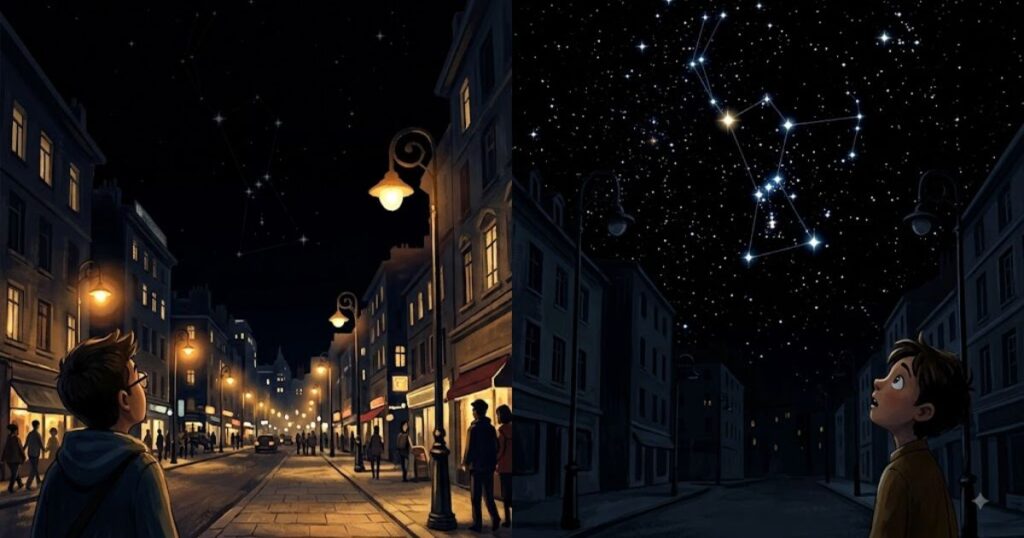
Real conditions can therefore reveal more of the night sky than a bright urban setting, but the available measurements do not establish a literal tenfold increase every night. Seeing ten times more stars would go beyond what ordinary dark-sky conditions provide, even though the basic effect is real: when less competing light reaches your eyes, more of the sky comes into view.
Looking back toward the same street where you first saw that fuller sky, you find the houses and streetlights unchanged, with Orion still above them. Nothing has been added to the sky; you have simply learned how much more of it your eyes can find.
As you step back inside, the cool air leaves your arms, and the door closes behind you, while the stars remain outside, still sending their light through the darkness, whether you notice it or not.
Nothing has been added to the sky. You have simply learned how much more of it your eyes can find.
Sources
The following sources were consulted while writing “What If You Could See 10 Times More Stars Every Night?“
- What determines the length of the day?
https://www.nist.gov/physics/explainers/what-determines-length-day - How many stars can a person see in the night sky?
https://www.skyatnightmagazine.com/space-science/how-many-stars-see-night-sky - How many stars are there in the universe?
https://skyandtelescope.org/astronomy-resources/how-many-stars-are-there/ - Best binoculars for stargazing and astronomy
https://www.skyatnightmagazine.com/advice/best-binoculars-for-astronomy - The images in this blog are created with the support of an AI tool and reviewed by the author.





Comments