

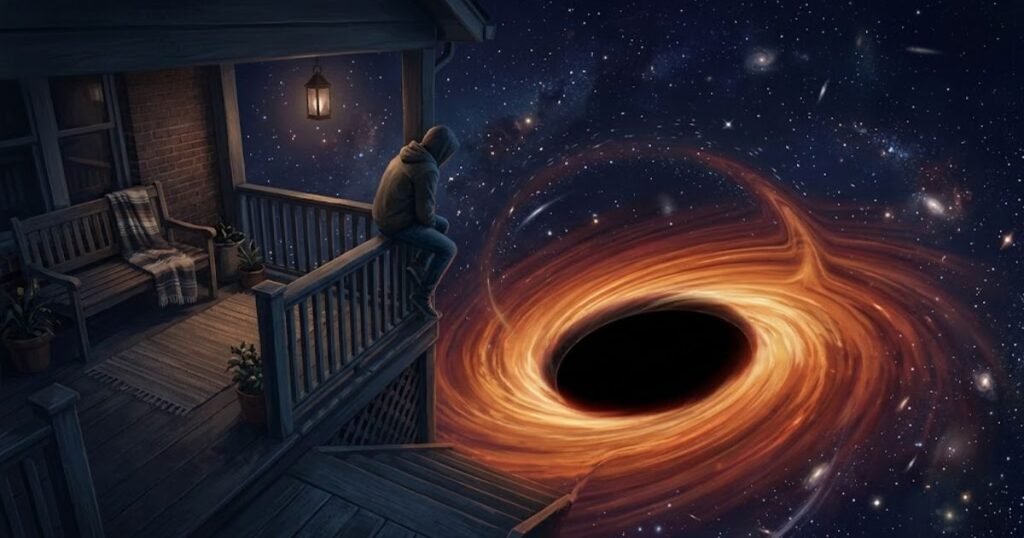
What if you fell into a black hole? Imagine the journey: gravity’s grip tightens, time distorts, and physics itself reaches its limit as you approach the singularity.
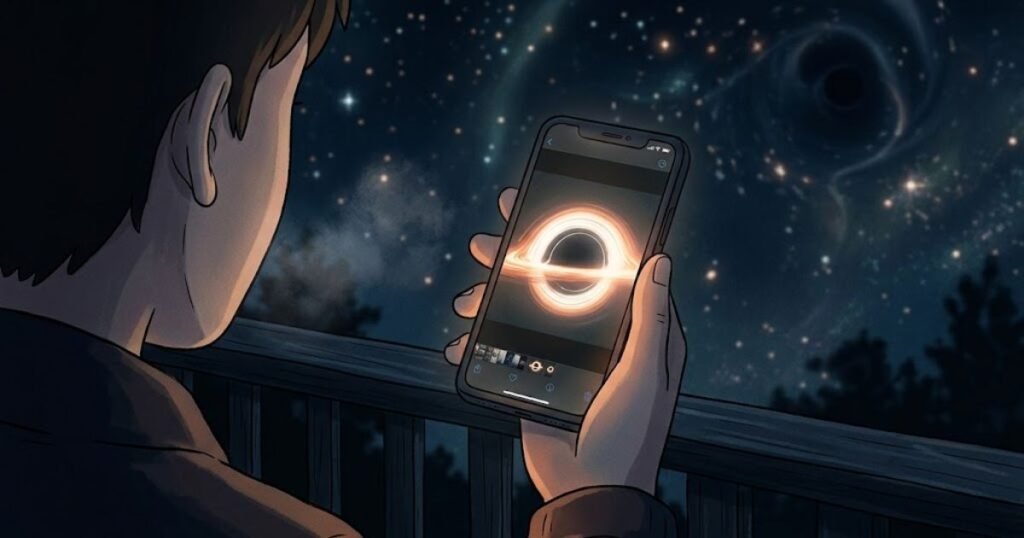
You are sitting on your porch late at night with your phone glowing in your hands. The air is cold, and wind rustles softly through nearby trees. Above you, the stars scatter across the dark sky, but most of the headlines blur past until one photograph breaks the pattern and captures your full attention.
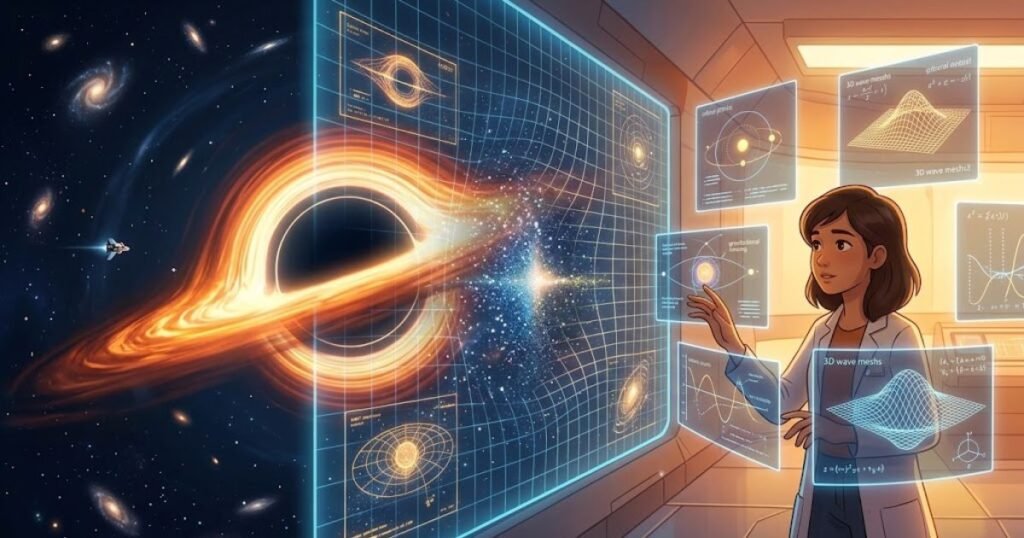
The photograph appears on your screen: a black hole at the center of a galaxy called M87*. An orange ring glows around it, and behind the ring sits a dark shadow. Within that shadow lies the event horizon. You stare at the dark centre, the void pulling your attention deeper into itself, and for a moment your mind holds the image still: a region where gravity has become so extreme that even light cannot escape.
Then a question forms, quiet but insistent: What if you fell into that?
The Approach Begins
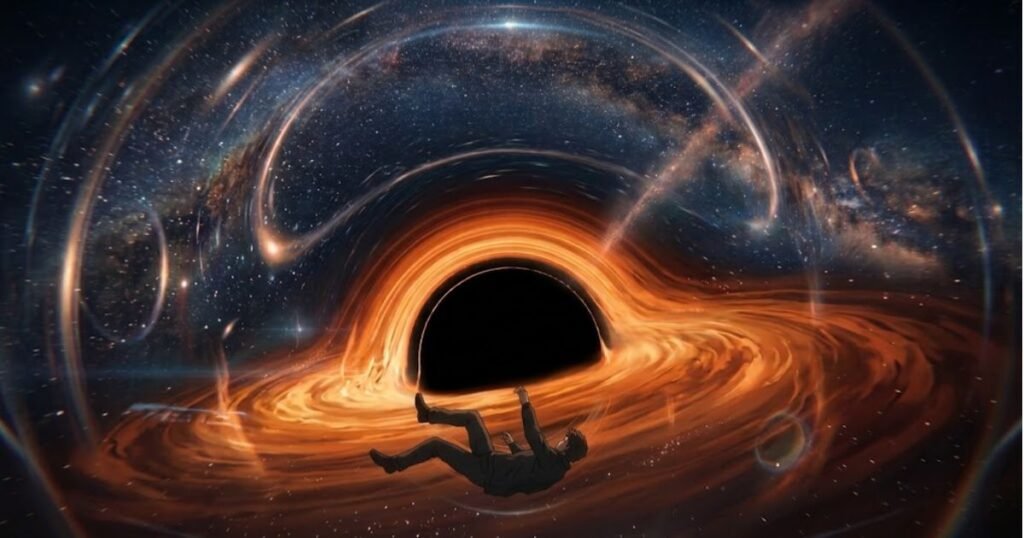
Suddenly, you feel yourself moving through space toward M87*, falling freely under its gravity with a weightlessness that suspends you in absolute nothing. At first, the experience feels almost peaceful. The stars remain steady around you; there is no sound, no vibration, only the smooth sensation of descent.
But your speed climbs with each passing moment as the black hole grows steadily larger ahead. Even though you cannot see how fast you are moving, the acceleration settles through you in subtle ways that begin to feel wrong, as your chest is being compressed from within.
The sight that awaits you now is a glowing orange ring below, surrounding a dark shadow. While you have seen images of this before, the difference between photograph and approach overwhelms that memory: this is not a screen, but the object itself pulling you inward. Your pulse quickens with the recognition of what you are falling toward.
Behind and above you, the stars no longer appear fixed in their patterns; light from different directions bends around the black hole, rearranging the sky into arcs and distortions.
This is the kind of sight no human has ever witnessed, and the beauty of it carries a quiet dread beneath it because you now understand that such impossible things actually exist in the universe around you.
The Point of No Return
The orange ring fills more of your vision as you approach the event horizon, that invisible boundary beyond which escape becomes impossible. As the realisation settles through you, it comes with absolute clarity: once you pass this boundary, every future movement takes you inward, and no path leads outward anymore.
Your speed will not diminish.
The horizon approaches with an inexorable pull that settles into your awareness; your breath comes faster, and your heartbeat climbs as you fall toward the end of choice itself. You cross it without ceremony.
Nothing happens. No impact arrives, no sensation of a threshold registers in your body.
The gravitational pull remains smooth and continuous; your body feels unchanged, and the stars still shine above while the orange ring still glows.
Yet something fundamental has shifted beneath this unchanged sensation, and with each passing moment the realization deepens: you cannot leave. Every instant that follows is descent, and the geometry of space itself has been remade around you. What comes next is no longer a matter of choice.

Gravity Takes Hold
The descent accelerates and brings with it a tension that runs through your body, subtle at first but growing with each moment; your feet experience a stronger gravitational pull than your torso, and your torso more than your arms.
This gradient is tidal force, the difference in gravitational strength across your body. Near a smaller black hole, such forces can become lethal before the horizon itself, but M87* is enormous, 6.5 billion times the Sun’s mass, so the gradient is gentler at first.
For a moment, the sensation is merely discomfort; you are aware of it but not overwhelmed by it.
Yet that mercy does not last. The gap between the gravitational pull at your feet and your head widens dramatically as you fall deeper, and what began as discomfort sharpens into pain that moves through your spine with increasing intensity. Your body elongates under the force, your breathing becomes laboured, and the geometry of space continues warping around you as light bends and distorts. Your vision compresses, and darkness closes in from the edges.
You push against the force instinctively, but it answers by pulling harder still.
Your vision blurs, and the pain becomes unbearable.
The Boundary of Physics
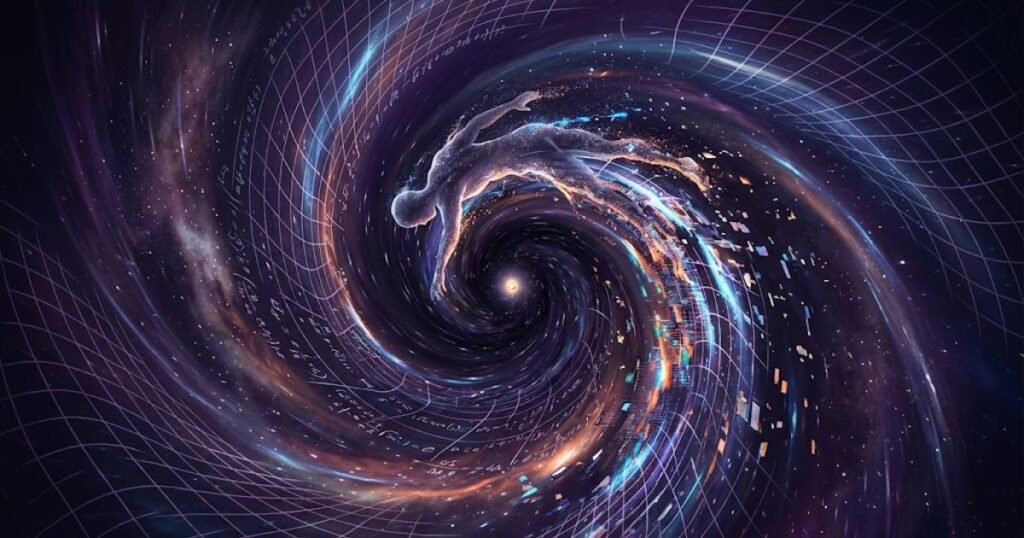
The fall continues deeper still, beyond the point where your body can endure it. As the pain reaches its limit and your consciousness begins to fragment, the descent carries you toward the centre where general relativity predicts something final: a singularity where spacetime reaches an extreme limit.
The equations that guided your fall stop providing a complete description here; they break down entirely. That singularity represents a boundary where the theory becomes incomplete, where the familiar laws of spacetime become untrustworthy and physics itself acknowledges the limits of its understanding.
Yet you approach it anyway, through territory where tested theories no longer apply, drawn toward a centre that no physics can yet describe.
This scenario remains worth exploring despite its impossibility, for falling into M87* is extraordinarily unlikely; it sits 55 million light-years away, far beyond any human reach.
What makes it worth exploring is that everything you experienced before the singularity rests on physics that is well-established: gravitational lensing has been observed, tidal forces are described by general relativity, and these effects have been confirmed through observation and experiment. What remains unknowable is what happens at the singularity itself, where physics stops providing answers and theory reaches its boundary.
The Night Sky, Seen Again
With this realization, you lower the phone slowly. You are still on your porch, the stars still scattered across the dark sky exactly as they were before you looked down at the screen. The air is cold; your breath is steady. The night looks exactly as it did before, ordinary in every way.
Yet how you understand the night sky has changed entirely. These scattered points of starlight are no longer distant suns in an orderly pattern, but markers of a cosmos you now know contains black holes and impossible things. The distance between the stars is no longer safety; it is simply distance. And within that distance hides what you have learned: the universe is stranger than any photograph can show.

Sources
The following sources were consulted while writing “What If You Fell Into a Black Hole?”
- What is a black hole event horizon, and what happens there?
https://www.space.com/black-holes-event-horizon-explained.html - What Happens if You Fall Into a Black Hole?
https://www.sciencenewstoday.org/what-happens-if-you-fall-into-a-black-hole-2 - What happens inside a Black Hole’s singularity
https://www.sciencenewstoday.org/what-happens-inside-a-black-holes-singularity - What happens when something gets too close to a Black Hole?
https://science.nasa.gov/universe/what-happens-when-something-gets-too-close-to-a-black-hole/ - Why are small black holes more dangerous than big ones?
https://www.astronomy.com/science/ask-astro-why-are-small-black-holes-more-dangerous-than-big-ones/ - The images in this blog are created with the support of an AI tool and reviewed by the author.


Comments