

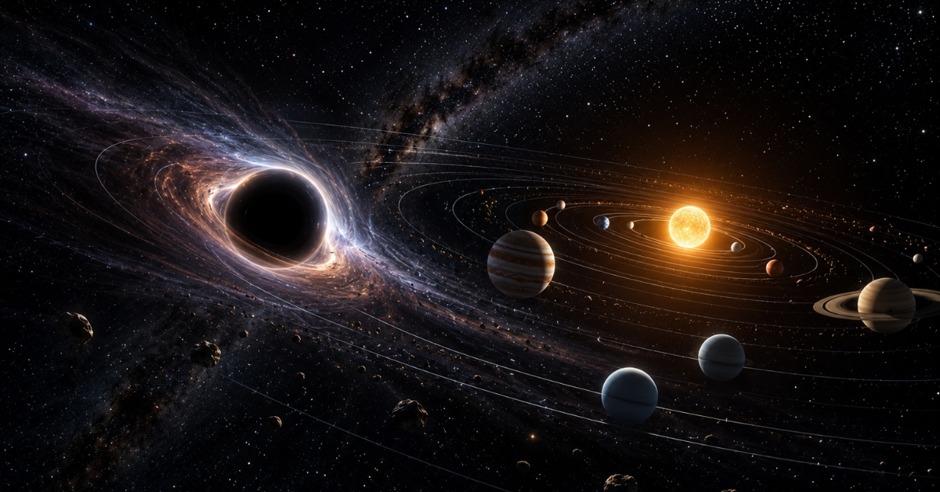
What if a black hole drifted through our solar system? Discover how invisible gravity could reshape planetary orbits, disrupt the seasons, and change the night sky long before anyone ever saw the danger.
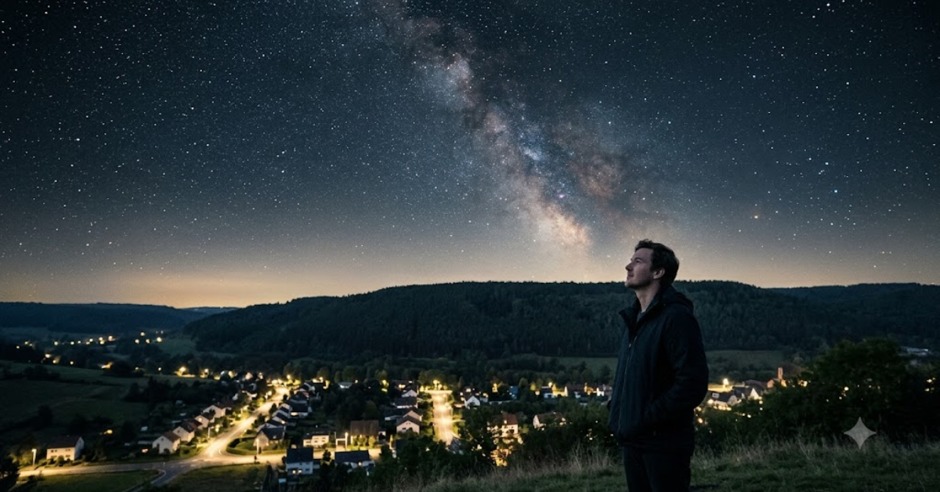
You step outside on a clear night, tilt your head back, and let the stars settle into your eyes. There is something quietly comforting about that view; the same sky you looked at as a child is still doing exactly what it always has, and nothing about it has ever given you a reason to feel uneasy. The planets circle the Sun, the Moon rises on time, and without really thinking about it, you trust all of that the way you trust the ground beneath your feet.
Then a softer thought arrives, almost too quiet to catch: what if something enormous and completely invisible were slowly drifting toward all of this, and you had no idea it was even there?
The Thing You Cannot See
Most people picture a black hole as something violent and consuming, which makes the whole idea feel more alarming than it actually is. A black hole is simply a very large amount of matter pressed into a small space, and it pulls on the things around it through ordinary gravity, the same force that keeps the Moon in its orbit and holds you to the ground. It moves through space without any light, without any signal, and without anything your eyes could detect even on the clearest night.
The only way anyone would know it was approaching is by noticing what it does to the objects around it, and that is where this story quietly begins.
Something Feels Off in the Sky
The first sign would not come as a headline. You would step outside, look up, and see nothing unusual; the stars exactly where they belong, the night feeling no different from any other.
Astronomers, though, would begin to notice something that did not sit right: comets arriving in unusual numbers, coming from directions that made no sense. Far beyond all the known planets sits a vast frozen shell of ancient ice and rock called the Oort Cloud, objects that have been drifting undisturbed since long before Earth had oceans. A passing black hole would reach that distant region well before coming anywhere near the inner planets, slowly pulling those frozen objects out of paths they have held for billions of years. Those ancient pieces of ice would begin heading towards the sun in growing numbers, and that gradual increase in comets would be the earliest sign that something out there had shifted.
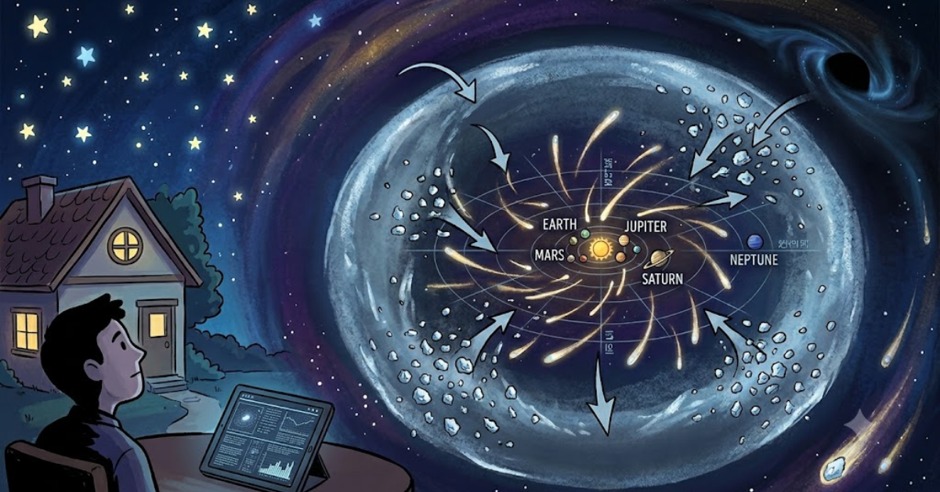
You would probably read about it over your morning coffee, feel a passing flicker of curiosity, and move on with your day; it would feel too distant to carry for long, and for a while, it would stay that way.
When the Planets Begin to Drift
Weeks would pass, then months, and the story would stay in the news longer than you expected. The way scientists were speaking about it would gradually change; their words becoming more careful, more precise, in a way that suggested something was being examined seriously.
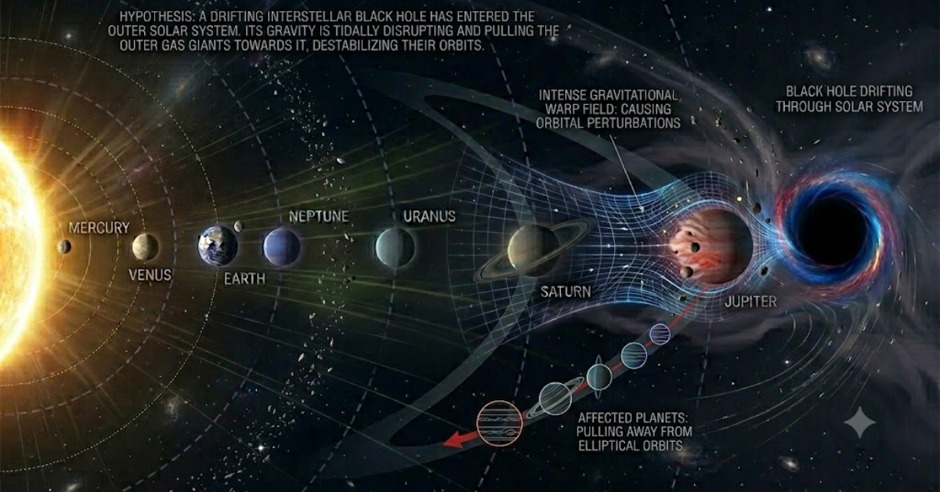
The outer planets, Neptune, Uranus, Saturn, and Jupiter, would feel the effects first, their orbits slowly shifting under a gravitational pull with no visible source. You would not notice anything directly yet, but something in the tone of things would feel slightly heavier than usual, the kind of weight that settles in when a situation is being managed rather than resolved.
Jupiter has been pulling in stray rocks and drifting debris for billions of years, a natural buffer between the outer solar system and Earth. The idea of it slowly moving out of its usual position would not cause immediate alarm, but it would leave a quiet, unsettled feeling; the kind that comes when something steady and reliable turns out to be less fixed than you assumed.
What You Would Start to Notice
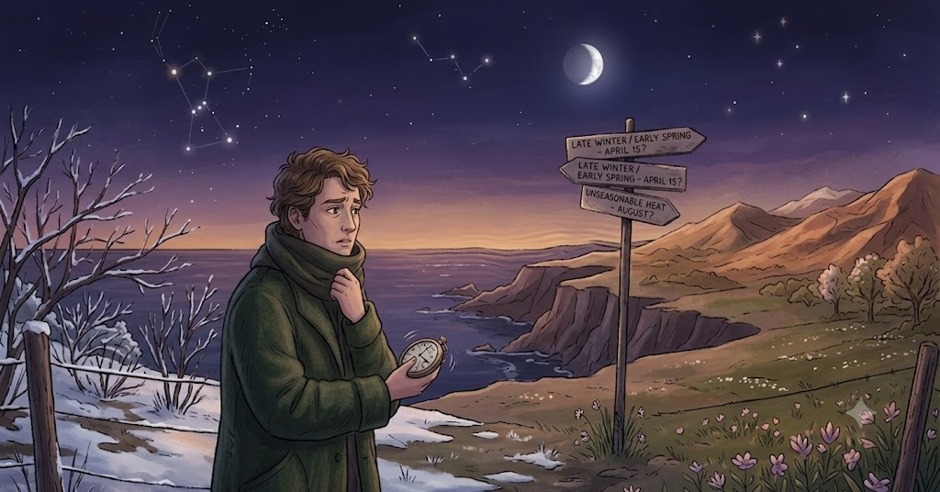
As the black hole moved further inward, effects would begin to expand to things closer to home. Earth’s orbit would start to shift; the seasons would arrive at the wrong times, running longer or shorter than usual, as if the familiar rhythm of the year had slowly gone off course. Winters would feel colder than you remembered, summers would arrive ahead of schedule, and there would be a growing sense that the patterns you had always relied on were no longer quite holding.
The sky each evening would still look the same, the stars in their usual places, the Moon rising as it always had; yet something in the air, something in the feel of the seasons arriving out of order, would suggest that things were changing in ways too gradual to see all at once. That kind of awareness is not sharp like fear; it is slower, more like the feeling of something dependable becoming uncertain, and you find yourself watching for signs without quite knowing what you are watching for.
The Reassuring Truth
This is the point where the scenario asks you to set its weight down for a moment. Scientists who study these questions are clear that a black hole passing close enough to affect our solar system is extremely unlikely; they are rare objects, and the probability of one coming near enough to disrupt within any human lifetime is very low.
This is not a situation anyone needs to prepare for; it is simply a way of understanding something that is already true about the solar system we live in. The stability of the planets, the steady rhythm of the seasons, the reliable path of the Moon, none of that is guaranteed by any fixed rule of the universe. It is the result of billions of years of balance holding together under the right conditions, long enough for life to appear, grow, and eventually start asking questions about what lies beyond the edge of everything familiar.
The Stars, Seen Differently
You step back outside, and the sky looks exactly as it did before. The stars are in their usual positions, the night is quiet, and nothing has changed.
Something about the look feels slightly different, though; a little more considered, a little more aware of what that steadiness actually represents. The solar system has been holding this arrangement for longer than anything on Earth has been alive to notice, and the fact that it has stayed this way long enough for you to stand beneath it feeling completely at ease is worth a moment of quiet recognition. The black hole moves somewhere out in the galaxy on its own path, the stars remain exactly where they are, and somehow knowing both of those things at once makes the night feel a little wider and a little more worth paying attention to than it did before you came outside.
Sources
The following sources were consulted while writing “What If a Black Hole Drifted Through Our Solar System?”
- Rogue black holes may abound in the Milky Way
https://www.science.org/content/article/rogue-black-holes-may-abound-milky-way - What would happen if a black hole wandered into our solar system
https://www.livescience.com/space/black-holes/what-would-happen-if-a-black-hole-wandered-into-our-solar-system - What happens when something gets ‘too close’ to a black hole?
https://science.nasa.gov/universe/what-happens-when-something-gets-too-close-to-a-black-hole/ - The process of stellar tidal disruption by supermassive black holes
https://link.springer.com/article/10.1007/s11214-021-00818-7 - Have the planets changed positions?
https://www.sciencing.com/planets-changed-positions-20126/ - The images in this blog are created with the support of an AI tool and reviewed by the author.


Comments