


What if you stop drinking water for 48 hours? Discover the stages of dehydration, brain fog, muscle cramps, and how your body fights to survive.
You wake up and slip into your morning routine almost on autopilot. Breakfast disappears between scrolling through your phone, emails pile up, one meeting flows into the next, and before you realize it, the morning is gone. When you finally glance at the clock, it is nearly lunchtime. Something feels slightly off, and then it hits you.
You have not taken a single sip of water since you woke up.
Even then, you brush the thought aside, telling yourself you’ll drink some later. It feels harmless, almost too small to matter.
But beneath that ordinary morning, your body has already noticed.
Deep inside your cells, an invisible countdown has begun. Every forgotten sip forces your body to conserve, adjust, and quietly ration the water it has left, buying time before the real warning signs appear.
Because long before you realize you’re dehydrated, your body already knows.
Why Is Water Essential for Your Body?
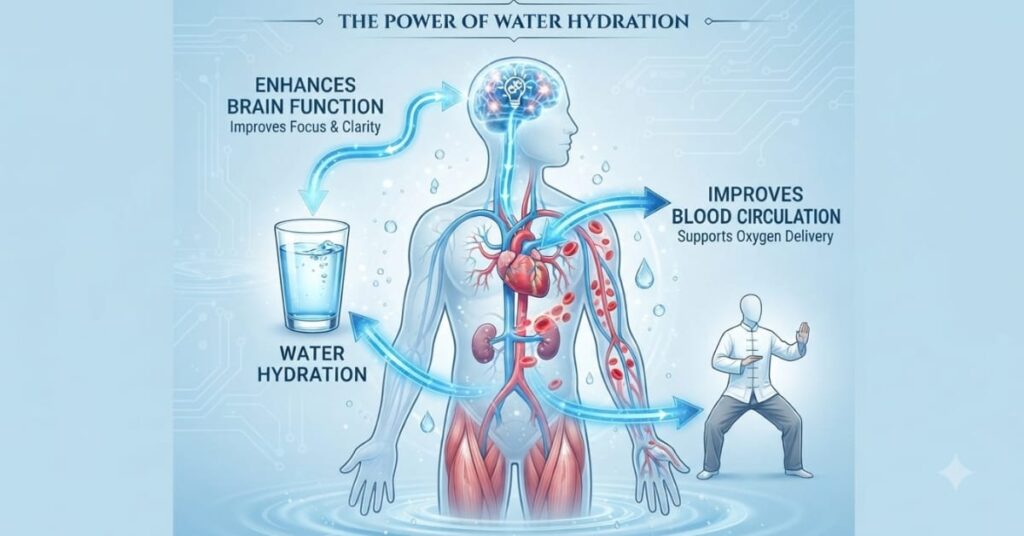
Long before thirst reaches your lips, water is already at work inside you. It helps your brain think, allows your blood to carry oxygen, and maintains the delicate balance that keeps every organ functioning. When water intake suddenly stops, your body does not panic. Instead, it quietly recalculates, conserving every drop it can to keep you alive.
That silent adaptation is exactly what makes dehydration so deceptive. By the time you notice something is wrong, your body has already been fighting the shortage for hours.
So what really happens if you stop drinking water for 48 hours?
Let’s follow your body, hour by hour.
First 12 Hours Without Water: Early Signs of Dehydration

Curiosity gets the better of you. You decide to keep going just a little longer.
One missed glass turns into an entire afternoon. The afternoon slips into evening, and before you realize it, you’re getting ready for bed. Twelve hours have passed without a single sip of water, and you convince yourself you’ll keep going.
At first, your body seems to cooperate. You finish your work, eat dinner, and carry on as though nothing has changed. But beneath that calm surface, the earliest stages of dehydration have already begun.
Now the dryness is impossible to ignore. Your mouth feels like sandpaper, your throat catches with every swallow, and something essential feels missing.
Soon, even distractions stop working. No snack, not even your secret chocolate stash, can pull your attention away because thirst has learned how to demand it. It nags relentlessly, like a coworker tapping your shoulder for the tenth time about a report. A faint wave of nausea joins in, lingering just long enough to make you uneasy.
You climb into bed, realizing you’ve gone nearly twelve hours without water.
Your body knows the hardest part hasn’t even begun.
24 Hours Without Water: Dehydration Symptoms Get Worse

Morning arrives. You head to the bathroom and immediately notice something different. There is very little urine, and what does come out is much darker than usual. You pause for a second, then remind yourself this is part of the experiment.
Breakfast doesn’t help either. You force down a couple of boiled eggs, hoping they’ll give you some energy, but every bite leaves your mouth drier. Soon, a dull headache settles in, refusing to let go.
Then the dizziness begins. You stand up, and the room tilts ever so slightly. Your heart starts beating faster as your body struggles to maintain circulation. Your thoughts feel heavier, every movement takes more effort, and for a brief moment, the racing heartbeat and lightheadedness feel unsettlingly similar to the beginning of a panic attack.
Meanwhile, your kidneys have fully switched into conservation mode, squeezing every possible drop from what little water remains. Dark urine and fewer trips to the bathroom are no longer subtle hints. They are clear signs that your body is rationing its last reserves.
By now, dehydration is no longer just making you uncomfortable. It is beginning to interfere with the way your body functions.
And you’re only halfway to 48 hours.
36 Hours Without Water: Brain Fog, Muscle Cramps, and Dry Skin

You wake up on the second morning feeling noticeably worse. As you sit up and catch your reflection in the bedroom mirror, your skin looks dull, dry, and stripped of its usual bounce. No moisturizer can replace what your body is missing from within.
Getting out of bed takes effort, and even simple thoughts feel strangely out of reach, as though your brain is trying to think through a thick fog.
As you walk across the room, a sharp muscle cramp suddenly grips your leg, stopping you in your tracks. Soon another follows. Your muscles tighten without warning, while your thoughts move like slow-loading files that never fully open.
Even breathing feels different. Thick mucus begins clogging your airways, making every breath feel heavier than it should. This is dyspnea, a warning that dehydration has moved far beyond ordinary thirst.
The unsettling part is that your body is still fighting to keep you alive.
But by now, it’s running out of ways to cope.
48 Hours Without Water: Severe Dehydration Symptoms
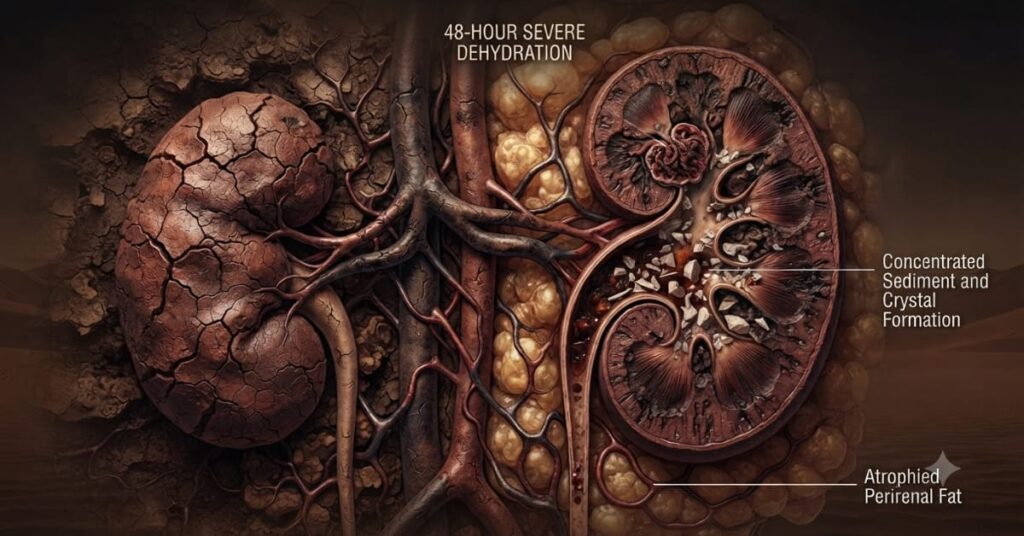
The second morning turns into afternoon, and you’ve finally reached the 48-hour mark. Every part of you is now begging for a single sip of water.
The trip to the bathroom brings almost nothing. Your kidneys are struggling, producing very little urine, and what remains is as dark as apple juice. Your body has exhausted nearly every reserve it has.
Standing up feels dangerous. Your heart pounds as blood volume drops and blood pressure falls, leaving you so dizzy the room seems to tilt beneath your feet. Your thoughts crawl, your arms and legs feel impossibly heavy, and simply staying upright becomes a challenge.
Inside your body, circulation continues to weaken. Waste products begin accumulating, triggering waves of nausea and a crushing exhaustion that settles deep into your bones.
At this stage, this is no longer something you can simply “push through.” By this stage, many people would need urgent medical attention, especially in hot conditions or after physical activity. Severe dehydration can quickly become life-threatening if fluids are not restored.
Reality Check: Can You Survive 48 Hours Without Water?
Now step out of the thought experiment.
Most people never reach 48 hours without water because the body fights back long before then. Thirst, dizziness, muscle cramps, and fatigue are not minor inconveniences; they are survival alarms telling you to stop.
Ignoring them is like driving on a flat tire and expecting to stay in control. Sooner or later, your body forces you to.
Why Staying Hydrated Matters More Than You Think
You don’t think about water when your body has enough of it.
But every heartbeat, every thought, and every breath depends on it.
The frightening part of dehydration isn’t how quickly it becomes dangerous. It’s how quietly it begins.
So before your body is forced to ask louder, answer the first whisper.
Sometimes, the most life-saving decision you’ll make today is simply taking the next sip.
Sources
The following sources were consulted while writing “What If You Stop Drinking Water for 48 Hours?”
- Dehydration
https://my.clevelandclinic.org/health/diseases/9013-dehydration - How long you can live without water
https://www.medicalnewstoday.com/articles/325174#effects - Adult Dehydration
https://www.ncbi.nlm.nih.gov/books/NBK555956/ - The images in this blog are created with the support of an AI tool and reviewed by the author.





Comments